Products / Auto Feeding Kit (AFK)
From manual to automatic, built around your boiler.
The Auto Feeding Kit (AFK) converts a manually fired biomass boiler or heater to automatic fuel feeding. There is no standard kit: what we fit depends on your boiler’s type and capacity, your fuel, and the space you have.
10 to 20%
higher combustion efficiency
Up to 25%
lower fuel cost
0.5 to 35 TPH
boiler range across four feeding methods
70+ installations
across Indian industry

There is no standard AFK. Yours is built to fit.
Every boiler room is different, so we design the fuel handling system around five things before we quote anything.
Boiler type and capacity
An integral-furnace boiler, a water-tube boiler and a thermic fluid heater each take a different feed method.
Fuel demand
How much fuel your process burns per hour sets the size of the hopper, bunker, conveyors and the motors.
Fuel type and size
Biomass fuels vary in size, calorific value, and bulk density. Some fuels need crushing first, some don't. Fuel handling system has to be designed accordingly.
Space available
A tight boiler room favours a compact inclined screw feeder or a plug-and-play external renewable-energy-combustor. A taller shed can take a bucket elevator and overhead bunker.
Two more things get customised around these: the furnace volume, reduced with refractory and insulation to suit automatic feeding, and the grate, changed from standard fire bars to fire plates suited to smaller, automatically fed fuel.
What manual firing actually costs you
Biomass boilers are still hand-fed across Indian industry, because that is how it has always been done. It is a costly habit.

Labour
Costly and hard to hire
Safety
Backfiring risk
Air
Excess air with every door opening
Fuel spread
Uneven on the grate
Result
Poor air-fuel mix, black smoke
Labour costs keep rising, and younger workers are increasingly reluctant to do this kind of hazardous work. Every door opened to feed fuel by hand lets in excess air and wastes heat, and fuel thrown in by hand never spreads evenly over the grate. The result is a poor air-fuel mix, black smoke, and fuel burned for no benefit.
Four ways to automate, one that fits your boiler
All four replace hand firing with automatic, controlled feeding. Which one we recommend depends on your boiler, your fuel and your space.
01
Briquette crusher, bucket elevator, bunker and screw feeders
Briquettes are crushed before going into an overhead bunker, then fed by screw feeders. Crushing adds a step, electrical load and some dust, but it opens the door to a wider range of fuels, including cheaper ones.
Fuel
Briquettes
Boiler capacity
1 to 35 TPH
02
Inclined screw feeder with spreader
Fuel drops into a hopper, an inclined screw carries it up, and a spreader box sprays it evenly into the combustion chamber. Compact, and it takes small-sized biomass with little adjustment and no crushing.
Fuel
Pellets, Astillas, wood chips, sawdust, sized briquettes
Boiler capacity
1 to 35 TPH
03
Multi-fuel external renewable-energy-combustor
A multi-fuel burner sits right in front of the boiler. It’s plug-and-play, with no modification to the boiler itself and no downtime to fit, and it’s the lowest-cost of the four.
Fuel
Pellets, Astillas, wood chips
Boiler capacity
0.5 to 5 TPH
04
Straight screw feeder with spreader
The same idea as the inclined version, a hopper, a screw conveyor and a spreader box, sized for small industrial and IBR boilers.
Fuel
Pellets, Astillas, wood chips, sawdust, sized briquettes
Boiler capacity
Under 1.5 TPH
How it's fitted to your boiler
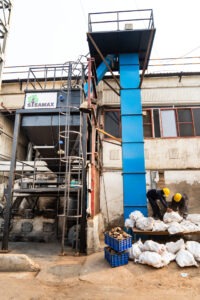
Three changes turn a hand-fed boiler into an automatically fed one.
1
Fuel handling system added
Sized and configured to your boiler's design, your fuel and the space you have, as one of the four methods above.
2
Furnace volume reduced
Automatic feeding needs less furnace volume than hand firing. Refractory and insulation are added to reduce it.
3
Grate changed
Standard fire bars are replaced with fire plates designed for smaller, automatically fed fuel, to cut wastage and lift efficiency.
Installing it
The fuel handling system is erected alongside your boiler first, while it keeps running. Then the boiler is shut down for 24 to 48 hours for the furnace and grate work, carried out by Steamax engineers & refractory masons.
You can still fire manually if you ever need to. The AFK adds automatic feeding; it doesn’t take away the option to feed by hand if a component ever needs attention.
What one customer in Goa measured
Real figures from a 10 TPH boiler, comparing manual briquette firing with automatic feeding on briquettes, and then on Astillas.
| Measure | Briquette, manual | Briquette, automatic | Astillas, automatic |
|---|---|---|---|
| Monthly steam load | 2,400 tonnes | 2,400 tonnes | 2,400 tonnes |
| Monthly fuel used | 706 tonnes | 632 tonnes | 435 tonnes |
| Steam-to-fuel ratio | 3.4 | 3.8 | 5.5 |
| Calorific value | 3,600 kcal/kg | 3,600 kcal/kg | 4,200 to 4,500 kcal/kg |
| Fuel price | ₹6.8/kg | ₹6.8/kg | ₹9.6/kg |
| Monthly fuel bill | ₹48,00,000 | ₹43,00,000 | ₹41,75,000 |
| Monthly saving vs. manual | — | ₹5,00,000 | ₹6,25,000 |
| Annual saving vs. manual | — | ₹60,00,000 | ₹75,00,000 |
Automation alone, keeping the same briquette fuel, cut the fuel bill by about 10%. Moving to Astillas on the same automatic feeder cut it by about 13%, and cut the tonnes of fuel burned by nearly 40%, because Astillas carries more heat per kilogram. Your own numbers depend on your boiler, fuel and prices.
Built for the fuel you already use
The AFK is flexible across clean biomass fuels, often with no or minimal adjustment.
Briquettes
Crushed for the bucket elevator method, or used sized and uncrushed with the screw feeder methods.
Pellets and wood chips
Uniform, small-sized fuels that suit every AFK configuration.
Rice husk and sawdust
Light, small-sized biomass, well suited to screw feeding.
Astillas
The Steamax biomass fuel, with a high calorific value, ash below 3% and steady supply all year. See Astillas.
70+ AFK installations, across industries
Fitted on boilers and heaters in pharma, food and beverage, packaging, textiles, tyres and cement plants.
Buy the kit, and let us handle what comes after
Once your boiler feeds automatically, Steamax can go further.
Buy the AFK
Sized to your boiler, fuel and space, and fitted by certified Steamax engineers.
How you pay
You keep manual feeding available as a fallback, and own and run the boiler as before.
Add fuel supply
We supply clean biomass fuel, including Astillas, delivered to your plant.
How you pay
You buy fuel as you need it, sized to what your new feed rate demands.
Add operations
Steamax operators run the boiler and the feeding system, and we take care of ash disposal.
How you pay
Fuel, operators and ash disposal are included in the price.
Questions about the AFK
Briquettes, pellets, Astillas, rice husk, wood chips, sawdust and similar biomass fuels. This flexibility means you can choose whichever fuel is most accessible and cost-effective where you are.
We look at your boiler type and capacity, how much fuel your process needs, the fuel type and size you plan to use, and the space you have. Those five factors point to one of four feeding methods, from a compact inclined screw feeder to a full bucket elevator and bunker.
The fuel handling system is erected alongside your boiler first, without stopping it. Then the boiler is shut down for 24 to 48 hours while certified Steamax engineers modify the furnace and change the grate. The approach is built to keep downtime to a minimum.
Yes. Switching between manual and automatic feeding stays possible, so a component issue, a fuel shortage, or a change in regulation never leaves you stuck. You keep the manual option you have today.
Automation typically raises combustion efficiency by 10 to 20%, and Steamax's own guidance is up to 25% lower fuel cost. In one documented case, automation alone cut a customer's fuel bill by about 10%, and moving to Astillas on the same automatic feeder cut it by about 13%, with nearly 40% less fuel burned. Your own numbers depend on your boiler, fuel and prices.
Yes. The straight screw feeder suits boilers under 1.5 TPH, the multi-fuel external renewable-energy-combustor covers 0.5 to 5 TPH, and the bucket elevator and inclined screw feeder methods scale up to 35 TPH.
Yes. Beyond the kit, we can supply biomass fuel, including Astillas, and take on operations and ash disposal, so you pay for the steam or heat delivered rather than managing the boiler yourself.
Tell us about your boiler. We'll size the feeding system.
Share its type, capacity, fuel and the space you have. We will come back with next steps for a site visit.