Summary: What You’ll Learn
- Air pollution control has become an important compliance requirement for industries across Delhi-NCR. Under CAQM Direction No. 98, specified industrial categories are subject to a particulate matter (PM) emission limit of 50 mg/Nm³, effective from 1 October 2026.
- An Air Pollution Control Device (APCD) must be capable of handling the emissions generated by the connected boiler, furnace or thermic fluid heater.
- An adequacy assessment helps determine whether the existing equipment can meet the applicable emission standards under actual operating conditions.
- This blog explains the importance of APCD adequacy assessment, regulatory requirements, testing procedures, common equipment problems and ways industries can improve their pollution control systems.
Industries across Delhi-NCR are facing increasing pressure to control air pollution and meet environmental regulations. CPCB and State Pollution Control Board (SPCB) notices, CAQM directions and corporate sustainability targets are making emission management an important part of industrial operations.
At the same time, fluctuating fossil fuel prices are encouraging manufacturers to explore alternative fuels such as biomass. However, switching to cleaner fuels alone does not guarantee compliance. The performance of the installed pollution control system is equally important.
Over time, dust accumulation, corrosion, damaged filter bags and inadequate maintenance can affect the performance of Air Pollution Control Devices (APCDs). This can lead to higher particulate emissions and difficulties in meeting prescribed limits. An APCD adequacy assessment helps industries identify these issues and determine whether their existing equipment requires maintenance, modification or replacement.
What Is APCD Adequacy Assessment?
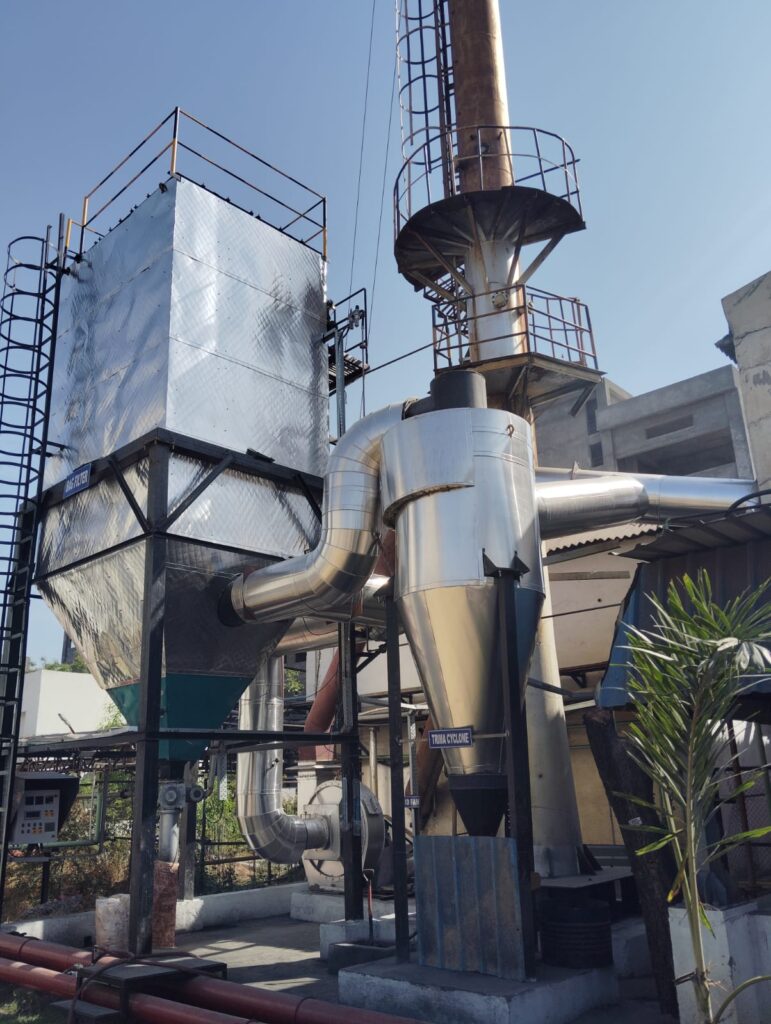
An APCD adequacy assessment is a technical evaluation of an installed pollution control system to determine whether it is properly designed, correctly sized, and capable of controlling emissions within applicable regulatory limits.
The assessment examines several parameters, including:
- Flue gas flow rate and temperature.
- Particulate matter loading.
- Equipment capacity and filtration area.
- Pressure drop and ID fan performance.
- Combustion and fuel-feeding conditions.
- Equipment condition and maintenance practices.
Stack emission testing is also conducted to measure particulate matter released through the chimney. These results are evaluated alongside equipment specifications and operating conditions.
Based on the findings, the APCD may be considered adequate or may require corrective measures such as maintenance, retrofitting or upgrading.
What Does CAQM Direction No. 98 Say?
CAQM Direction No. 98 introduces a particulate matter emission limit of 50 mg/Nm³ for specified industrial categories in Delhi-NCR, effective from 1 October 2026.
The applicable categories include:
- 17 specified categories of industries.
- Medium and large red-category air-polluting industries.
- Food and food-processing industries.
- Textile industries operating boilers or thermic fluid heaters.
- Industries using metal furnaces.
To support compliance, CPCB has issued the Procedure for Adequacy Assessment of Air Pollution Control Devices for boilers, thermic fluid heaters and furnaces in Delhi-NCR.
The important requirements include:
- Meeting emission limits: Applicable industries must ensure that their particulate matter emissions remain within the prescribed limit.
- Assessment by empanelled OEMs: APCD adequacy testing must be conducted through Original Equipment Manufacturers (OEMs) empanelled by the National Productivity Council (NPC), as applicable under the procedure.
- Upgradation of inadequate systems: If an existing APCD cannot meet the required standards, industries must retrofit or install suitable pollution control equipment through the prescribed empanelled OEMs.
Industries should check the relevant direction to confirm its applicability to their specific category and equipment.
Who Needs APCD Adequacy Assessment?
The requirements under CAQM Direction No. 98 apply to specified industrial categories operating in Delhi-NCR.
These include relevant medium and large red-category industries, food-processing units, textile industries with boilers or thermic fluid heaters, and industries operating metal furnaces.
The exact applicability depends on the industrial category, installed equipment and relevant regulatory provisions.
Even when an assessment is not specifically mandated, evaluating APCD performance can help manufacturers identify equipment problems early, improve operational reliability and reduce the risk of emission-limit exceedances.
Who Can Conduct the Assessment?
Industries covered under the prescribed procedure must get their installed APCDs assessed through NPC-empanelled Original Equipment Manufacturers.
The list of empanelled OEMs can be checked through the National Productivity Council and the relevant CPCB APCD portal.
The assessment generally includes physical equipment inspection, operational checks, stack emission testing, technical evaluation and preparation of the adequacy assessment report and certificate.
How Is APCD Adequacy Testing Performed?
APCD adequacy testing involves more than measuring emissions at the chimney outlet. It evaluates the pollution control equipment along with the connected boiler or furnace to understand whether the complete system is performing as intended.
Step 1: Review Documents and Applicable Standards
The assessment begins with a review of boiler or furnace capacity, fuel type, APCD design specifications, Consent to Operate (CTO) and previous stack emission reports.
The applicable emission limit is identified based on the industry category and location.
Step 2: Inspect the APCD, Furnace and Stack
A physical inspection helps identify dust leakage, ash accumulation, inadequate draft, damaged components and combustion-related problems.
The stack is also inspected to check sampling port diameter, position and accessibility for proper emission monitoring.
Step 3: Conduct Stack Emission Testing
Stack emission testing measures particulate matter concentration in the flue gas released through the chimney.
Important parameters include:
- Suspended Particulate Matter (SPM/PM).
- Flue gas velocity and volume flow rate.
- Oxygen and moisture content.
- NOx and SOx, wherever required.
In India, IS 11255 Part 1 provides guidance on particulate matter measurement, while Part 3 covers flue gas velocity and volume flow rate measurement.
Isokinetic Sampling and PM Determination
Isokinetic sampling is used to collect a representative flue gas sample for particulate matter analysis. A sampling probe fitted with a nozzle, pitot tube and particulate collection assembly is inserted into the stack.
The sampling system draws gas at approximately the same velocity as the flue gas flowing through the stack. Particulate matter is collected in a thimble, while instruments measure temperature, pressure and flow conditions.
For evaluating APCD removal efficiency, samples are collected from both the inlet and outlet using suitable sampling arrangements.
The samples are analysed by an NABL-accredited laboratory. As indicated in the supplied assessment process, laboratory analysis generally takes around 6–8 days, depending on testing requirements.
Step 4: Evaluate Operating Performance
The assessment also examines whether the equipment is operating within its design capacity.
For bag filters, important parameters include filtration area, air-to-cloth ratio, pressure drop, gas flow rate and cleaning performance.
For boilers and furnaces, combustion stability, fuel feeding, ash carryover and heat-transfer performance are also evaluated.
Step 5: Prepare the Assessment Report
The inspection findings, operating parameters and stack emission results are compared with the applicable standards.
If deficiencies are identified, recommendations may include replacing damaged filter bags, improving combustion, correcting fuel-feeding issues, modifying the APCD or installing upgraded equipment.
Follow-up testing may be required to verify performance after corrective action.
Why Do Existing APCD Systems Fail?
An installed pollution control system may lose efficiency over time due to several technical and operational problems.
- Outdated design: Older systems may not have been designed for current emission requirements or operating conditions.
- Inadequate capacity: The APCD may not be able to handle the actual flue gas flow rate or particulate loading.
- Poor maintenance: Dust accumulation, corrosion, blockages and damaged components can reduce performance.
- Changes in fuel quality: Variations in moisture and ash content can affect combustion and particulate generation.
- Faulty components: Problems with fans, pumps, dampers, spray nozzles and dust discharge mechanisms can affect overall performance.
Looking for APCD Adequacy Assessment?
Steamax supports industries with APCD adequacy testing, stack emission assessment, technical recommendations and pollution control system upgrades.
Visit Steamax to explore its environmental and industrial solutions.