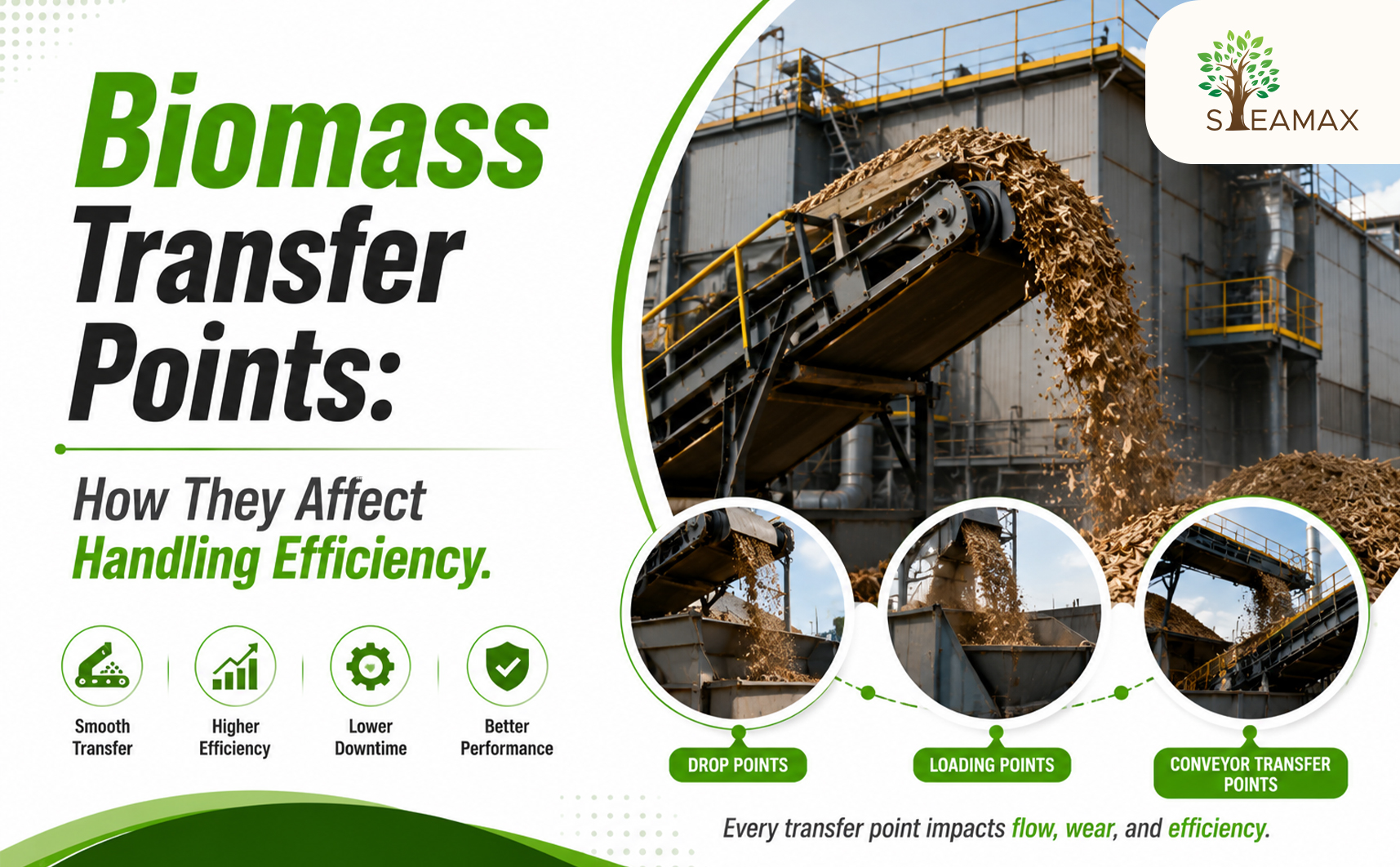
Biomass handling looks straightforward on paper. Fuel moves from one conveyor to another, travels through the handling system, and eventually reaches the boiler.
But in practice, the transfer point—where biomass changes direction or moves between conveyors—can become one of the most troublesome parts of the system.
Poorly designed transfer points can cause fuel spillage, dust, blockages, uneven feeding, and unnecessary wear. On the other hand, a well-designed transfer point keeps the fuel moving smoothly and helps the entire biomass handling system work reliably.
So, if a biomass boiler is facing repeated fuel-handling problems, transfer points are worth a closer look.
What Is a Transfer Point in Biomass Handling?
A transfer point is the location where biomass moves from one piece of handling equipment to another.
For example, fuel may move:
Storage → Conveyor → Transfer Chute → Conveyor → Bunker → Fuel Feeder → Boiler
Every change in direction, height, or conveying equipment creates a transfer point.
The challenge is to move biomass from one stage to the next without excessive impact, blockage, spillage, or segregation.
Why Transfer Points Matter for Biomass Handling Efficiency
Biomass isn’t a uniform material.
Unlike many free-flowing industrial materials, biomass can vary in:
- Particle size
- Moisture
- Shape
- Density
- Bulk characteristics
A transfer point that works well for one fuel may struggle with another.
When the chute geometry doesn’t match the fuel characteristics, biomass can slow down, accumulate, or bridge inside the system.
That directly affects biomass handling efficiency.
1. Poor Chute Design Can Restrict Fuel Flow
The transfer chute guides biomass from one conveyor to the next.
If the chute has sharp direction changes, inadequate clearance, or unsuitable geometry, material can accumulate inside it. Over time, the buildup can block flow.
2. Biomass Can Bridge at Transfer Points
Bridging is a common concern when handling fibrous or irregular biomass.
Long pieces, moist material, and inconsistent particle sizes can become lodged together, creating a temporary blockage. Once material starts to accumulate, the problem can quickly grow.
3. Excessive Impact Can Increase Fuel Damage
Biomass doesn’t always respond well to aggressive handling.
When fuel falls from excessive heights or repeatedly impacts hard surfaces, it can break apart and create more fines. Those fines can create additional challenges downstream, including dust and uneven fuel distribution.
4. Poor Transfer Points Can Increase Dust
Dust generation is another issue that often gets overlooked.
When biomass falls freely through a transfer point, fine particles can become airborne.
This can lead to:
- Dust around conveyors
- Poor housekeeping
- Material loss
- Increased occupational concerns
- Additional cleaning requirements
5. Uneven Fuel Flow Can Affect Boiler Feeding
A biomass handling system ultimately has one important job: deliver fuel consistently to the boiler.
If transfer points cause irregular flow, the fuel feeder may receive material in surges rather than at a steady rate.
Inconsistent fuel feeding may result in fluctuations in:
- Furnace temperature
- Steam generation
- Combustion air requirements
- Boiler load
Designing Better Biomass Transfer Points
No single transfer-point design works for every biomass application. The design should consider the actual fuel and operating conditions.
Important factors include:
- Fuel Characteristics
Consider moisture, particle size, bulk density, and the presence of long or fibrous pieces before finalizing the chute design.
- Conveyor Speed
The speed of the incoming and receiving conveyors affects how smoothly biomass moves through the transfer point.
- Drop Height
Excessive drop height can increase impact, dust, and material degradation.
- Chute Geometry
The chute should provide a smooth path for the biomass while avoiding areas where material can accumulate.
- Access for Maintenance
Even a good design needs inspection and cleaning. Transfer points should therefore provide practical access for maintenance teams.
How Better Transfer Points Improve Biomass Handling
A well-designed transfer system can make a noticeable difference to day-to-day plant operation.
It can help reduce:
- Fuel spillage
- Conveyor blockages
- Dust generation
- Manual cleaning
- Equipment wear
- Fuel feeding fluctuations
Final Thoughts
Transfer points may look like simple sections of a biomass handling system, but they’re often where small design issues turn into recurring operational problems.
Poor transfer design can contribute to blockages, spillage, dust, uneven fuel flow, and higher maintenance.
So, are you facing repeated blockages, spillage, or uneven biomass feeding?
Steamax provides integrated biomass fuel-handling solutions, including conveyors, transfer systems and automated fuel feeding, designed around each plant’s fuel and operating requirements.
Talk to Steamax about improving your biomass handling efficiency. www.steamaxindia.com