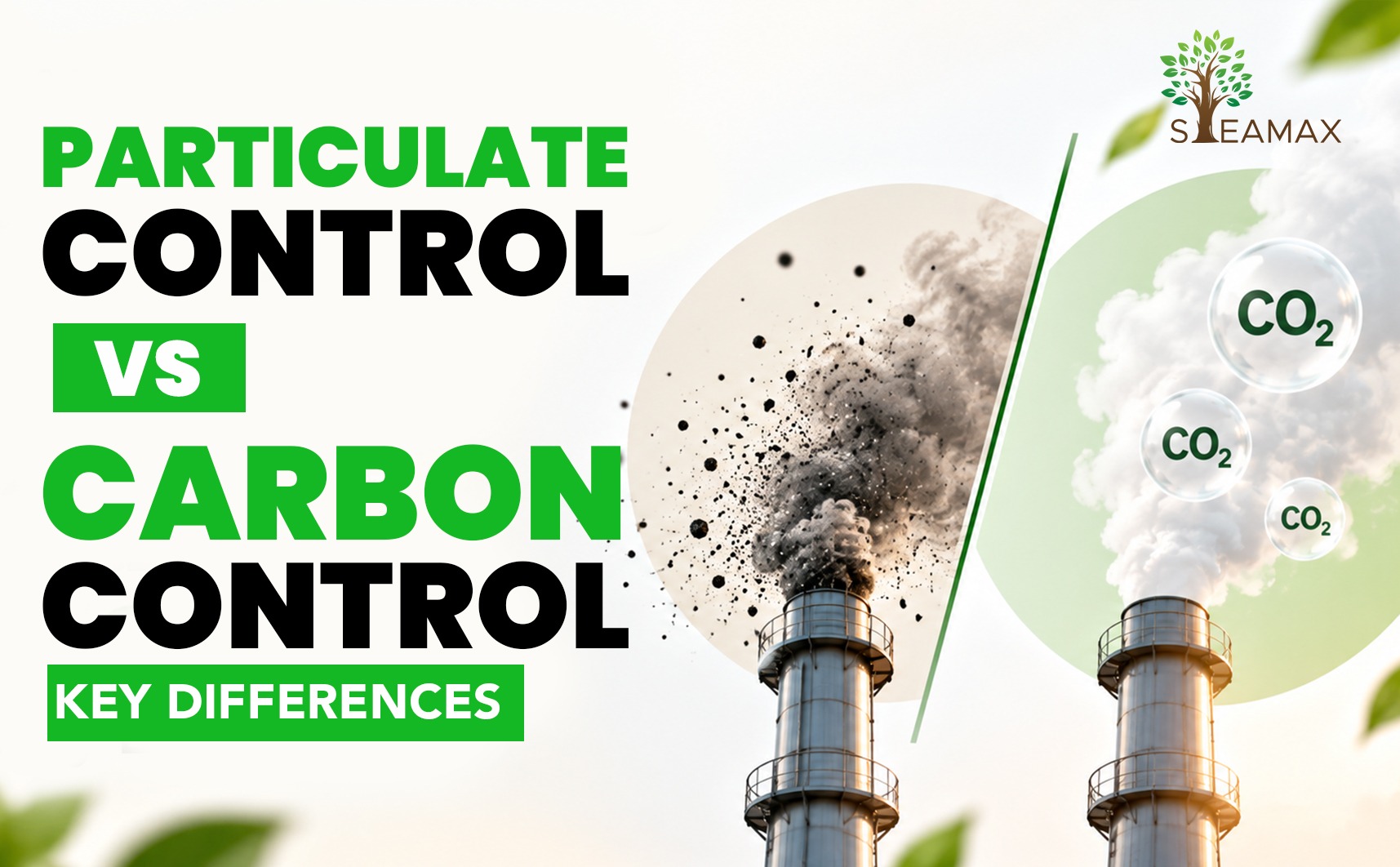
Industrial emission management is no longer about treating pollution as a single problem. Particulate control and carbon control address different types of emissions and require different strategies, technologies, and monitoring approaches.
For industries operating boilers, furnaces, manufacturing systems, and other thermal equipment, understanding this difference is becoming increasingly important. A system designed to control particulate matter may not address carbon emissions, while reducing carbon emissions doesn’t automatically mean particulate requirements have been met.
That’s why businesses need to look at these as two separates but connected compliance tracks.
What Is Particulate Control?
Particulate control focuses on reducing the release of solid or liquid particles into the atmosphere. These particles can come from fuel combustion, material handling, manufacturing, grinding, processing, and other industrial activities.
Common particulate-control technologies include:
- Bag filters for capturing dust and fine particles.
- Electrostatic precipitators (ESPs) for separating particles from exhaust gases.
- Cyclones for removing larger particles.
- Wet scrubbers for capturing particles and certain gaseous pollutants.
The right technology depends on the process, emission characteristics, operating conditions, and applicable environmental requirements.
Effective particulate control can help industries reduce dust emissions, improve air quality, and meet applicable emission limits.
What Is Carbon Control?
Carbon control generally focuses on reducing or managing carbon dioxide (CO₂) and other greenhouse-gas emissions.
Unlike particulate matter, carbon emissions aren’t simply particles that a conventional dust-control system can collect. Carbon management often starts with the energy source itself.
Industries may consider:
- Improving fuel efficiency.
- Reducing unnecessary energy consumption.
- Recovering waste heat.
- Switching to lower-carbon energy sources.
- Improving process efficiency.
- Exploring carbon-capture technologies where appropriate.
Particulate Control vs Carbon Control: What’s the Difference?
The simplest way to understand the difference is to ask what each strategy is designed to control.
Why Separate Compliance Tracks Matter
An industrial facility may have an efficient particulate-control system and still generate substantial CO₂ emissions.
For example, a bag filter can capture particulate matter from an exhaust stream, but it isn’t designed to remove CO₂. Similarly, reducing fuel consumption can lower carbon emissions while still requiring appropriate particulate-control equipment.
That’s why facilities should:
- Identify each emission source.
- Determine which pollutants are being generated.
- Review the applicable requirements.
- Select technology according to the pollutant.
- Monitor equipment performance.
- Maintain proper compliance records.
How Industrial Facilities Can Prepare
Companies can start by mapping their major emission sources, including boilers, furnaces, generators, process equipment, and material-handling systems.
They should then evaluate both pollution-control performance and energy consumption.
For steam and thermal systems, this can mean looking at combustion efficiency, fuel usage, heat losses, particulate-control equipment, and applicable monitoring requirements together.
Steamax works in industrial steam and thermal-energy solutions and operates in an industry where energy efficiency and emissions management are closely connected. However, the appropriate solution always depends on the facility’s specific process, fuel, equipment, and regulatory requirements.
For India-specific compliance, businesses should verify current requirements with relevant authorities such as the Central Pollution Control Board (CPCB) and applicable State Pollution Control Boards.
Final Takeaway
Particulate control vs carbon control isn’t about choosing one over the other. They’re two different areas of environmental management that need to work together.
By understanding what each system controls, monitoring the right parameters, and keeping up with applicable requirements, industries can build a more complete and practical emissions-management strategy.