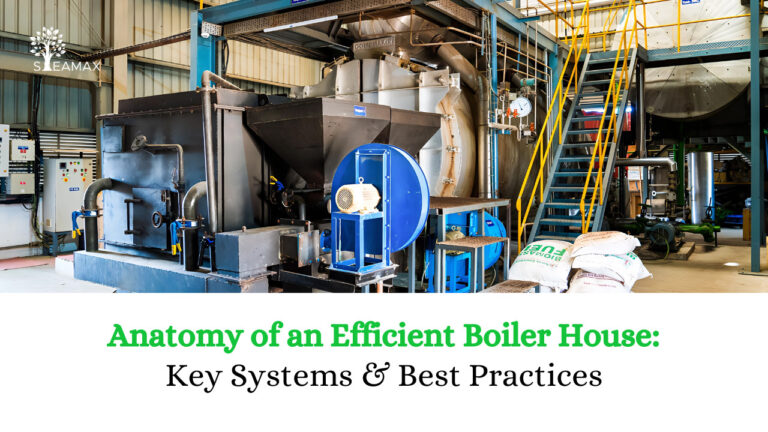
The boiler is designed for a certain pressure, the plant has a steam requirement, and the system runs at that pressure.
But there’s more to it.
The boiler operating pressure can affect how much energy the plant spends generating, distributing, and using steam. Running at a pressure higher than the process needs may increase energy requirements, while operating too low can create problems such as inadequate process pressure and an unstable steam supply.
What Does Boiler Operating Pressure Mean?
Boiler operating pressure is the pressure at which the boiler generates and supplies steam.
The process generally determines the required pressure. Food processing, textiles, chemicals, paper, pharmaceuticals, and other industries can have very different steam requirements.
That’s why you shouldn’t select boiler pressure in isolation.
The boiler, steam distribution network, control valves, process equipment, and condensate system must work together.
Why Higher Pressure Doesn’t Automatically Mean Better Steam
It’s easy to assume that higher-pressure steam is always more useful.
But higher pressure also means higher steam temperature and can increase the energy required to produce the steam.
If a process only needs lower-pressure steam, generating steam at a significantly higher pressure and then reducing it through a pressure-reducing valve can create an avoidable energy penalty.
The steam may still do its job, but the plant may be paying more to produce it than necessary.
How Pressure Influences Steam Generation Cost
One of the biggest factors in steam economics is the energy required to generate steam.
As boiler pressure changes, the thermodynamic properties of steam and feedwater change. This affects how much useful heat you must supply to produce the required steam.
So, when comparing steam costs at different pressures, fuel consumption alone isn’t enough.
You should consider:
- Steam generation pressure
- Feedwater temperature
- Boiler efficiency
- Fuel cost
- Blowdown
- Steam distribution losses
- Process requirements
The Hidden Cost of Pressure Reduction
Here’s a common situation in industrial plants.
A boiler generates high-pressure steam, but the process requires much lower pressure. A pressure-reducing valve then reduces the steam pressure before it reaches the process.
The PRV does its job, but the plant has already generated steam at the higher pressure.
If the system doesn’t need that higher pressure, the plant may be carrying an unnecessary energy burden.
Higher Pressure Can Still Be Useful
This doesn’t mean industries should simply lower boiler pressure.
Higher-pressure steam can be valuable when:
- The process genuinely requires it.
- Steam needs to travel long distances.
- Multiple processes operate at different pressures.
- Steam is being used for power generation or other high-pressure applications.
What Happens When Pressure Is Too Low?
Going too low can be just as problematic.
If the operating pressure falls below the process requirement, the plant may experience:
- Inadequate heat transfer
- Slow process heating
- Reduced production capacity
- Unstable temperature control
- Poor performance of steam-operated equipment
Boiler Pressure Also Affects Steam Quality
Pressure management is closely connected with steam quality.
Poorly controlled systems can suffer from wet steam, pressure fluctuations, or inadequate separation.
Steam quality matters because the process ultimately needs useful heat—not simply a pressure reading on the boiler gauge.
Therefore, consider good steam separation, proper distribution, insulation, and condensate management alongside pressure optimisation.
A Practical Way to Optimise Boiler Pressure
Before changing the boiler operating pressure, start with the process.
Ask a few simple questions:
- What pressure does each major process actually require?
- Where are pressure-reducing valves being used?
- Are there significant pressure losses in the distribution network?
- Is the boiler routinely operating at a pressure higher than necessary?
- Are steam traps, insulation, and condensate recovery working properly?
How Steamax Can Help
Steamax approaches steam economics from an engineering perspective rather than looking at the boiler alone.
A review of the steam system can help identify opportunities related to:
- Boiler operating conditions
- Fuel consumption
- Combustion efficiency
- Steam generation cost
- Steam distribution
- Condensate recovery
- Performance
Final Takeaway
Boiler operating pressure isn’t just a number on the pressure gauge. It can influence the economics of steam generation, distribution, and process heating.
Too much pressure can mean unnecessary energy expenditure, while too little can affect production and process performance.
So, do you want to know whether your boiler is operating at the most economical pressure?
Steamax helps industries evaluate performance, combustion efficiency, steam systems, and operating conditions to identify practical opportunities for reducing steam generation costs.
For more information visit – www.steamaxindia.com