
Summary
- Biomass briquettes offer industries a practical way to use renewable solid fuels, but their size, handling requirements, and compatibility with existing combustion equipment can create operational challenges.
- This article explains why briquettes may be difficult to automate, how fuel characteristics influence combustion and emissions, and what industries should consider when comparing briquettes with pellets, loose biomass, and Astillas.
Biomass briquettes have gained popularity across India as industries look for alternatives to coal and other fossil fuels. Made by compressing agricultural residues, sawdust, and other biomass materials, briquettes offer several practical benefits. They’re easier to handle than many loose biomass fuels, can provide a relatively consistent fuel size, and may help businesses make productive use of agricultural waste.
Steamax has worked with biomass fuels for industrial applications for many years. Since 2010, the company has supplied biomass briquettes to industries across India, helping businesses explore alternatives to conventional fossil fuels. This experience has also highlighted an important point: a fuel that works well in one boiler may not be the best choice for another.
Although biomass briquettes have advantages, they can pose challenges for automated feeding, combustion control, worker safety, and equipment compatibility. Understanding these limitations before switching fuels can help industries avoid unnecessary capital expenditure and operational problems.
What Are Biomass Briquettes?
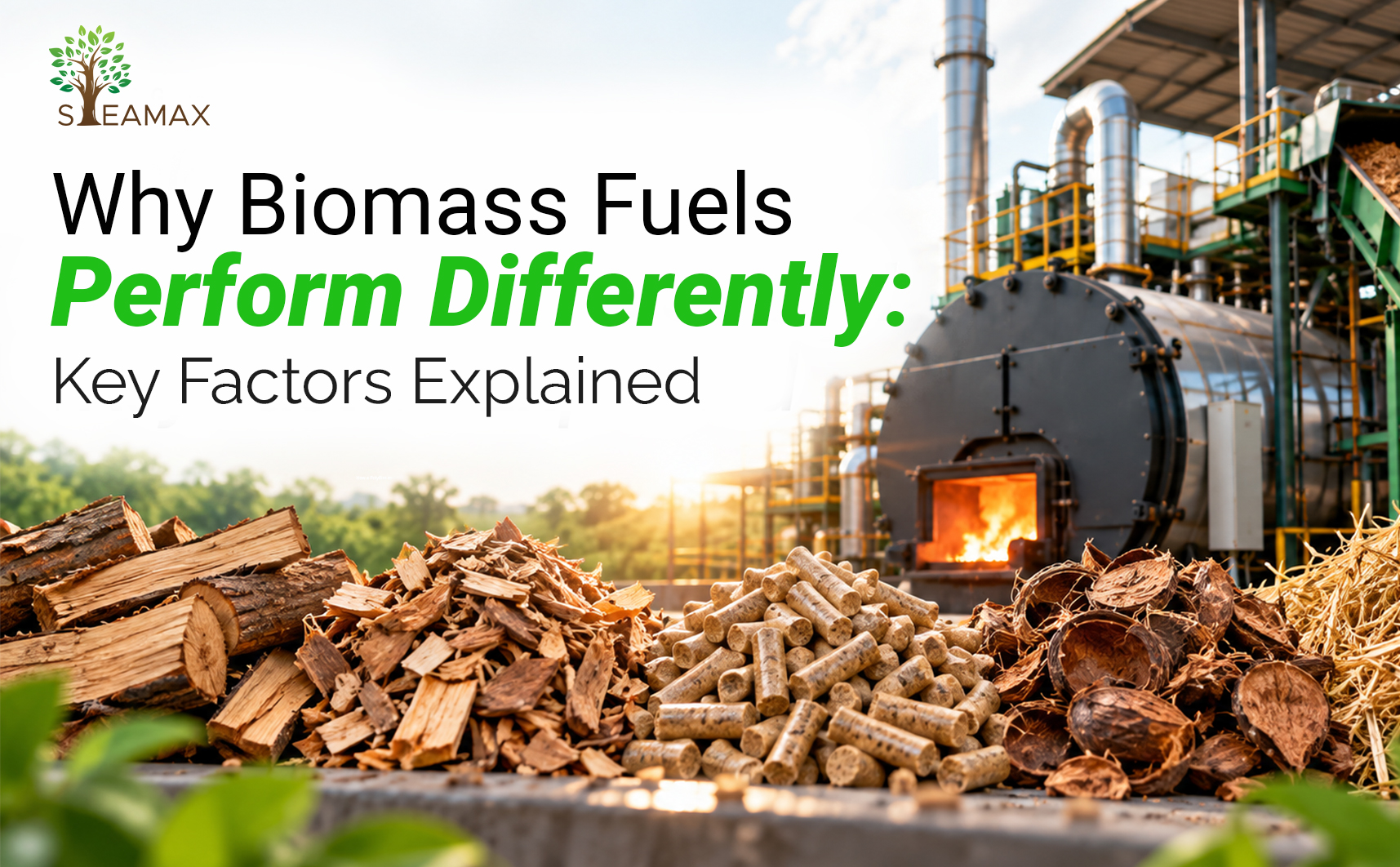
Biomass briquettes are compressed blocks or cylinders made from materials such as sawdust, rice husk, groundnut shells, and other agricultural or forestry residues. Compression increases bulk density, making the material easier to store and transport than many unprocessed biomass residues.
Their performance, however, depends on several factors:
- Calorific value: The amount of heat released during combustion, generally expressed in kcal/kg or MJ/kg.
- Moisture content: Water in the fuel absorbs heat as it evaporates, reducing the useful energy available.
- Ash content: Mineral matter remains after combustion and can increase ash-handling requirements, cause deposits, or lead to clinker formation.
- Size and shape: Fuel dimensions influence storage, feeding, air distribution, and combustion.
- Mechanical strength: Briquettes that break apart during handling can create fines and inconsistent fuel flow.
Not all briquettes have the same characteristics. Their Suitability depends on the raw material, manufacturing process, storage conditions, and boiler design.

The Main Challenges of Biomass Briquettes
1. Fuel-Feeding Automation
Industrial boilers and thermal heating systems can use manual or automated solid-fuel feeding. Although manual feeding may require relatively little initial investment, it can create significant challenges in industrial environments.
Risks associated with manual feeding
- Manually loading briquettes through a fire door requires workers to operate close to hot surfaces and combustion equipment. Workers may face risks from radiant heat, sudden flame flare-ups, hot gases, and accidental contact with heated components.
- Manual feeding can also create inconsistent fuel supply. If operators add too much fuel at once, combustion conditions may change abruptly. If they add too little, heat output may fall. These variations make it harder to maintain a stable operating temperature.
- A well-designed automatic feeding system can reduce the need for frequent manual handling and deliver fuel more consistently. However, automation must be matched to the fuel’s physical characteristics and the boiler’s requirements.
Why briquettes can be difficult to feed automatically
Many biomass briquettes are considerably larger than the particles used in systems designed for small, uniform solid fuels. Depending on their dimensions and strength, briquettes may bridge in hoppers, jam at feed openings, or fail to move reliably through screw conveyors and other feeding equipment.
Existing coal-feeding systems may also be unsuitable for certain briquette types. Compatibility depends on the conveyor dimensions, hopper geometry, feed mechanism, and the fuel’s tendency to break or deform.
Crushing briquettes into smaller pieces may appear to solve the problem, but it can introduce other concerns:
- Additional crushing equipment and electricity consumption.
- Dust generation and the need for suitable dust-control measures.
- Variable particle sizes that may affect fuel flow.
- Additional maintenance and material-handling requirements.
- Potential contamination concerns in food-processing or pharmaceutical facilities.
As a result, some plants may need to modify their feeding arrangements or invest in new Equipment before they can automate briquette handling.
2. Combustion Properties and Heat-Transfer Performance
A solid fuel’s burning behaviour depends on more than its calorific value. Particle size, moisture, composition, air supply, and combustion-chamber design all influence how efficiently the fuel releases heat.
Briquettes are compressed into relatively large pieces. Depending on their dimensions and density, they may take longer to heat up and burn through than smaller particles. Their outer surfaces can burn while the interior is still heating or releasing combustible gases.
Smaller particles generally provide more surface area per unit mass, which can help them heat up and react more quickly. However, smaller fuel doesn’t always perform better. Very fine particles can be carried away by combustion air, create dust, or burn too rapidly for a system designed for slower fuel release.
The best particle size depends on the combustion equipment.
Why air-fuel mixing matters
Complete, stable combustion requires an appropriate fuel-to-air balance, along with sufficient temperature, mixing, and residence time.
If briquettes are fed irregularly, or if their size and moisture vary substantially, combustion may become less stable. Poorly adjusted systems can experience unburned fuel, higher carbon monoxide emissions, smoke, or reduced useful heat output.
3. Efficiency Losses During Manual Feeding
Manual feeding through a fire door can disturb the combustion chamber. Opening the door may let hot gases escape and introduce uncontrolled air, changing the furnace’s pressure and temperature.
The scale of these losses varies with the system’s design, operating procedure, and feeding frequency. They shouldn’t be assumed to be the same for every boiler.
Repeated disturbances can make temperature control harder, especially in processes that require a steady heat supply. For industries such as food processing, drying, roasting, and manufacturing, fluctuations may affect production consistency.
Automated feeding can help maintain a more continuous fuel supply. Still, automation alone doesn’t guarantee better efficiency. The system also needs appropriate combustion-air control, proper fuel preparation, and regular maintenance.
4. Smoke, Emissions, and Air-Quality Concerns
Biomass is often promoted as an alternative to coal, but burning biomass doesn’t automatically eliminate smoke or emissions. Actual performance depends on fuel quality, combustion conditions, equipment design, and pollution-control systems.
Poor combustion can generate visible smoke, carbon monoxide, and particulate matter. High-moisture fuel may require more energy to dry during combustion, while inconsistent feeding can make combustion harder to control.
Ash characteristics also matter. Some biomass fuels contain minerals that can contribute to deposits or clinker formation under certain furnace conditions. The risk varies with the raw material and combustion temperature.
Industries should therefore evaluate fuel alternatives using measurable operating data, including:
- Fuel consumption per tonne of product or per unit of useful heat.
- Stack oxygen and carbon monoxide readings, where appropriate.
- Particulate emissions measured using a suitable test method.
- Ash quantity and handling requirements.
- Boiler or heater temperature stability.
- Compliance with the applicable emissions standards and consent conditions.
5. Higher Capital Costs for Automation
For facilities currently using manually fed briquettes, moving to an automated system may require more than installing a conveyor. Depending on the existing Equipment, a plant may need a redesigned hopper, metering device, fuel-size reduction system, control panel, or combustion chamber modifications.
These changes can increase capital expenditure and may require planned downtime for installation.
Before investing, industries should compare the total cost of each option rather than looking only at the purchase price per kilogram of fuel. Relevant expenses include:
- Fuel purchase and transportation.
- Fuel storage and handling.
- Electricity used by conveyors and preparation equipment.
- Labour requirements.
- Maintenance and spare parts.
- Ash removal and disposal.
- Boiler or heater efficiency.
- Installation costs and production downtime.
Biomass Briquettes vs. Pellets vs. Astillas
| Factor | Biomass Briquettes | Biomass Pellets | Steamax Astillas |
|---|---|---|---|
| Physical Form | Large compressed blocks or cylinders | Small, compact cylindrical particles | Prepared biomass fuel blend |
| Automated Fuel Feeding | May require modifications to existing feeding systems because of briquette size | Suitable for compatible pellet-feeding systems | Compatibility depends on the Astillas specifications and the feeding system |
| Combustion Performance | Depends on briquette size, density, moisture, and furnace design | Small particle size can support rapid combustion in suitable equipment | Performance depends on fuel composition, moisture, particle size, and heater design |
| Equipment Compatibility | May not fit existing coal feeders or screw conveyors | Usually requires a compatible pellet-feeding arrangement | Should be assessed against the existing fuel-feeding system and heater requirements |
| Fuel Handling | Easy to stack and transport, but large pieces may complicate automated feeding | Convenient for metered feeding when pellet quality is consistent | Requires suitable storage and handling arrangements for the specific blend |
| Potential Operational Challenges | Feeding blockages, manual handling, and inconsistent combustion in unsuitable systems | Dust, fines, moisture variation, and feeding issues | Fuel quality, particle-size consistency, moisture, and equipment compatibility |
| What to Check Before Switching | Briquette dimensions, calorific value, moisture, ash content, and feeder compatibility | Pellet dimensions, durability, moisture, fines, and feeder specifications | Calorific value, moisture, ash content, particle size, and compatibility with the industrial heater |
| Best Application | Industrial systems designed or adapted for briquette combustion | Systems designed for pellet feeding and combustion | Industrial heating applications where the specific Astillas blend has been evaluated and approved |
Make a Better-Informed Biomass Fuel Decision
Biomass briquettes can be a useful alternative to conventional fuels, but their performance depends on more than price and availability. Feeding automation, particle size, combustion control, moisture, emissions, and equipment compatibility all affect their Suitability for industrial use.For some facilities, briquettes may remain a practical choice. Others may benefit from evaluating pellets, Astillas, or different prepared biomass fuels that better match their equipment and production requirements.
The approach is to compare fuel specifications, test compatibility, and calculate the cost of useful heat before investing in a conversion.If you're considering a biomass fuel change, contact Steamax to discuss your industrial heating requirements.