
Summary
- Pellet burners can provide an effective heating solution when pellets are readily available at competitive prices. However, their feeding mechanisms and burner designs may limit the fuels they can handle.
- Steamax’s Multi-Fuel Burner (MFB) is designed to accommodate a broader range of biomass fuels, including Astillas.
- This article compares pellet burners and multi-fuel burners, explains key design improvements, and outlines what industries should consider before switching.
Industrial heating plays a vital role in manufacturing, food processing, drying, roasting, and many other applications. For industries looking to reduce their dependence on diesel, biomass burners have become an attractive alternative.
Pellet burners have gained popularity because they automate fuel feeding and offer a practical way to replace diesel-fired heating systems. In suitable applications, switching from diesel to biomass pellets can significantly reduce fuel costs. However, the actual savings depend on fuel prices, calorific value, burner efficiency, and operating conditions.
Another challenge: many pellet burners are designed for a specific fuel size and type. When pellet prices rise or alternative biomass fuels become more attractive, businesses may find their existing equipment limits them.
That’s where Steamax’s Multi-Fuel Burner (MFB) comes in. Designed to handle a broader range of biomass fuels, the MFB gives industries greater flexibility in fuel selection, including the option to use Steamax’s biomass blend, Astillas.
Why Are Industries Looking Beyond Pellet Burners?
Pellet burners can work well when the fuel matches the equipment specifications and is available at a competitive price. But relying on a single biomass fuel type can create problems when market conditions change.
1. Limited Fuel Compatibility
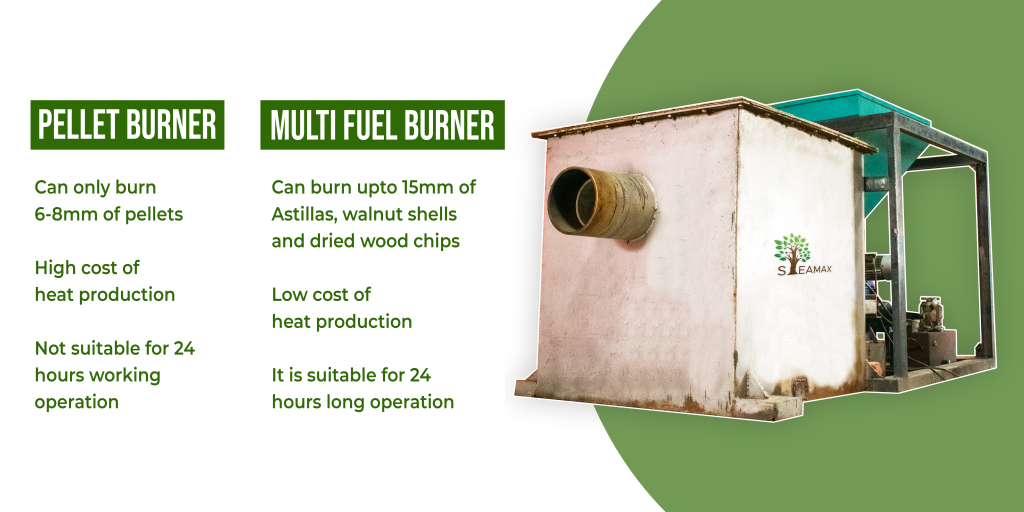
Many pellet burners are designed for small, uniform biomass pellets, often around 6–8 mm in diameter. The exact specification depends on the burner model.
Their feeding mechanisms, combustion chambers, and air-distribution systems are engineered around these pellets’ physical properties. As a result, a burner designed for one pellet specification may not perform reliably with larger or differently shaped biomass fuels.
Alternative fuels such as dried wood chips, nutshells, and prepared biomass blends can differ in size, shape, density, moisture, and flow characteristics. These differences affect how the fuel moves through the hopper and feeder and how it burns inside the combustion chamber.
2. Feeding Problems with Larger Biomass Fuels
The feeder is one of the most important components of an automatic biomass burner.
In a pellet burner, the screw conveyor and its pitch are typically selected for a particular fuel size and flow rate. Larger fuel particles may not move consistently through the feeder. Depending on the design, they can bridge in the hopper, become trapped, or jam the feeding mechanism.
A larger particle may also behave differently from a pellet of the same mass. Biomass fuels with lower bulk density take up more volume per kilogram, so the feeder must deliver the required mass without overfilling or interrupting combustion.
3. Unburnt Fuel Carryover
Another challenge is moving fuel from the feeding mechanism into the combustion zone.
If the burner geometry is poorly matched to the fuel, smaller or lighter particles may be carried away by the airflow before they burn completely. This can increase unburnt fuel carryover and reduce the energy released in the intended combustion zone.
Carryover depends on several factors, including:
- Fuel particle size and density.
- Combustion-air velocity.
- Burner nozzle geometry.
- Fuel feed rate.
- Combustion temperature and residence time.
A well-designed burner must balance fuel delivery and airflow to keep combustible particles in the right zone long enough to burn effectively.
Steamax Multi-Fuel Burner: A More Flexible Approach
Steamax developed its Multi-Fuel Burner (MFB) to address limitations of fuel-specific burner designs.
The main design features include:
1. Modified Hopper Design
Different biomass fuels behave differently inside a hopper. A fuel’s particle shape, surface characteristics, moisture, and bulk density all influence how easily it flows.
A hopper that works well for uniform pellets may not perform as effectively with irregular biomass particles. Material can accumulate along the walls or form a bridge above the outlet, interrupting the fuel supply.
Steamax’s MFB uses a modified hopper angle intended to improve material flow for suitable alternative fuels, including dried wood chips, nutshells, and Astillas.
2. Upgraded Feeder System
A multi-fuel burner needs a feeding mechanism that can accommodate differences in particle size and bulk density.
Steamax’s MFB incorporates changes to the feeder diameter and screw pitch to support the feeding of a wider range of biomass materials. These design changes are intended to improve fuel delivery when handling fuels that differ from conventional pellets.
A suitable feeder should deliver a consistent fuel quantity without frequent blockages or interruptions. Stable feeding helps the combustion system maintain a more consistent heat output.
3. Astillas: An Alternative Biomass Fuel
Fuel flexibility is particularly useful when industries want to evaluate alternatives to conventional biomass pellets.
Astillas is Steamax’s biomass fuel blend, developed for industrial heating applications. Steamax promotes it as an alternative for businesses seeking more flexibility in their biomass fuel selection.
The potential advantages of using an alternative biomass blend depend on its actual specifications and how well it performs in the intended equipment.
When evaluating Astillas against pellets, industries should compare:
- Calorific value: The energy released per kilogram of fuel.
- Moisture content: Higher moisture can reduce the useful heat available.
- Ash content: This affects ash handling and may influence deposits or clinker formation.
- Bulk density and particle size: These affect storage, feeding, and combustion.
- Fuel price and transportation: Both affect delivered fuel cost.
- Combustion performance: Actual results depend on the burner, air supply, and operating conditions.
4. Improved Burner Nozzle Design
The burner nozzle helps direct fuel and combustion air into the combustion zone. Its geometry influences how fuel enters the chamber and how long particles remain exposed to the required combustion conditions.
According to Steamax’s design approach, the MFB uses a higher burner nozzle centre height to reduce carryover of unburnt fuel particles.
The objective is to improve fuel retention and support more effective combustion. However, actual performance depends on the fuel being used, airflow, temperature, and burner operating settings.
What Should You Check Before Switching to a Multi-Fuel Burner?
Before replacing an existing pellet burner, take these practical steps:
-
Review your current heating system. Identify the burner model, heat requirement, operating temperature, and existing fuel-feeding arrangement.
-
Identify the alternative fuel. Obtain specifications for calorific value, moisture, ash, particle size, and bulk density.
-
Confirm equipment compatibility. Ask the supplier which fuels are approved and whether changes to storage, feeding, or combustion equipment are required.
-
Compare useful-heat costs. Evaluate fuel cost alongside efficiency, transportation, maintenance, and labour.
-
Conduct a controlled trial. Measure fuel consumption, heat output, production consistency, ash generation, and emissions.
-
Check emissions compliance. Ensure the proposed fuel and burner combination meets the requirements applicable to your facility.
Choose Fuel Flexibility for Your Industrial Heating System
Pellet burners can be effective when suitable pellets are available at competitive prices. But if fuel restrictions or changing market conditions are affecting your operations, evaluating a multi-fuel system may help you explore additional options.
Steamax's Multi-Fuel Burner is designed to accommodate a broader range of suitable biomass fuels, while Astillas offers another option for industrial users considering alternatives to conventional pellets. The right choice depends on your process, fuel specifications, equipment compatibility, and total operating cost.
Ready to explore alternative biomass fuels for your industrial heating system?Contact Steamax to discuss your requirements.