
Summary
- Industrial boilers supply essential steam to sectors such as pharmaceuticals, textiles, paints, and pesticides. However, reliance on fossil fuels can raise operating costs and expose businesses to fuel-price volatility and environmental compliance requirements.
- Steamax’s Oil to Biomass Retrofit Kit (OBR) offers a potential route to biomass-based heating without automatically requiring the purchase of a completely new boiler. This article explores the challenges of fossil-fuel boilers, the benefits of retrofitting, and the factors industries should consider before switching.
Steam is essential to many industrial processes, including heating, drying, sterilization, chemical processing, and textile manufacturing. Industries such as pharmaceuticals, paints, pesticides, and textiles rely on boilers to deliver the steam required for consistent production.
Traditionally, many facilities have generated steam using coal, furnace oil, diesel, or other fossil fuels. Although these fuels have supported industrial development for decades, their operating costs, emissions, and volatile supply prices can challenge modern businesses.
Replacing an existing boiler with a new biomass boiler may be an option, but it can involve significant capital expenditure, installation work, and production downtime.
Is there another way to transition from fossil fuels to biomass without replacing the entire boiler?
Steamax offers the Oil to Biomass Retrofit Kit (OBR), designed to help suitable industrial facilities explore a transition from oil-fired heating to biomass. By evaluating the existing installation and the proposed retrofit, businesses can determine whether this approach meets their steam requirements and financial objectives.
Why Are Fossil Fuel Boilers Becoming More Challenging to Operate?
Fossil fuel boilers can remain suitable for some applications, but several factors are encouraging industries to assess alternative heating solutions.
1. Rising and Unpredictable Fuel Costs
Fossil fuel prices can fluctuate because of changes in international markets, transportation costs, supply conditions, and taxes. These fluctuations make it harder for industrial businesses to predict their long-term steam-generation expenses.
For facilities that consume large quantities of fuel every day, even a modest price increase can significantly affect monthly operating costs.
Biomass may offer an alternative, particularly when suitable agricultural or forestry residues are available at competitive prices. However, the financial benefit depends on the biomass fuel’s calorific value, moisture content, delivered price, and combustion system efficiency.
2. Emissions and Environmental Compliance
Burning fossil fuels releases carbon dioxide and can also produce nitrogen oxides, particulate matter, and other pollutants, depending on the fuel and equipment.
Industries must manage these emissions in accordance with applicable environmental standards and operating permissions.
Biomass can offer an alternative to fossil fuels, but it isn’t automatically pollution-free. Poor combustion can produce smoke, carbon monoxide, and particulate emissions. Biomass systems therefore need appropriate combustion control, fuel-quality management, and any required pollution-control equipment.
3. Ash Handling and Workplace Safety
Ash management is an important consideration for coal-fired and biomass-fired boilers. Ash quantity and characteristics depend on fuel composition and combustion conditions.
Manual handling can increase labour requirements and expose workers to dust and hot material. Poor housekeeping may also let ash accumulate around equipment and work areas.
Biomass fuel may produce less ash than some other solid fuels, but this isn’t guaranteed. Ash content varies considerably among different biomass materials.
4. High Capital Expenditure for a New Biomass Boiler
One reason industries delay switching fuels is the cost of installing a new boiler.
A complete boiler replacement may involve purchasing new equipment, modifying the boiler house, installing fuel storage and feeding systems, updating controls, and arranging commissioning. Depending on the facility, the work may also require engineering approvals and a planned production shutdown.
These expenses can make a complete replacement difficult for businesses with limited capital budgets.
A retrofit may provide another option when the existing boiler is technically suitable for conversion. Instead of replacing the entire installation, the project focuses on modifying the relevant combustion and fuel-handling systems.

Introducing Steamax’s OBR Kit: The Hassle-Free Solution
Steamax has developed the Oil to Biomass Retrofit Kit (OBR) to address these challenges. This kit offers a seamless transition from fossil fuels to biomass, enabling industries to shift without the drawbacks associated with traditional boilers. Here’s how the OBR Kit can benefit your operations:
- Automated Fuel and Ash Management: The OBR kit includes an automatic fuel feeding and ash removal system, significantly reducing labour costs and ensuring a cleaner, safer work environment.
- Cost Reduction: With the OBR kit, fuel costs can be reduced by up to 20-25%, making it a financially sound investment for any industrial operation.
- Consistent Production: We ensure seamless coordination between the supply and demand of biomass fuel, eliminating production delays and boosting overall productivity.
- Zero Carbon Emissions: The OBR kit enables a switch to biomass, resulting in zero carbon emissions. It supports a more sustainable, pollution-free environment and aligns with global environmental goals.
- Steam at Cost Services: We offer a unique “Steam at Cost” service, allowing you to save on fuel costs from day one, contributing directly to your bottom line.
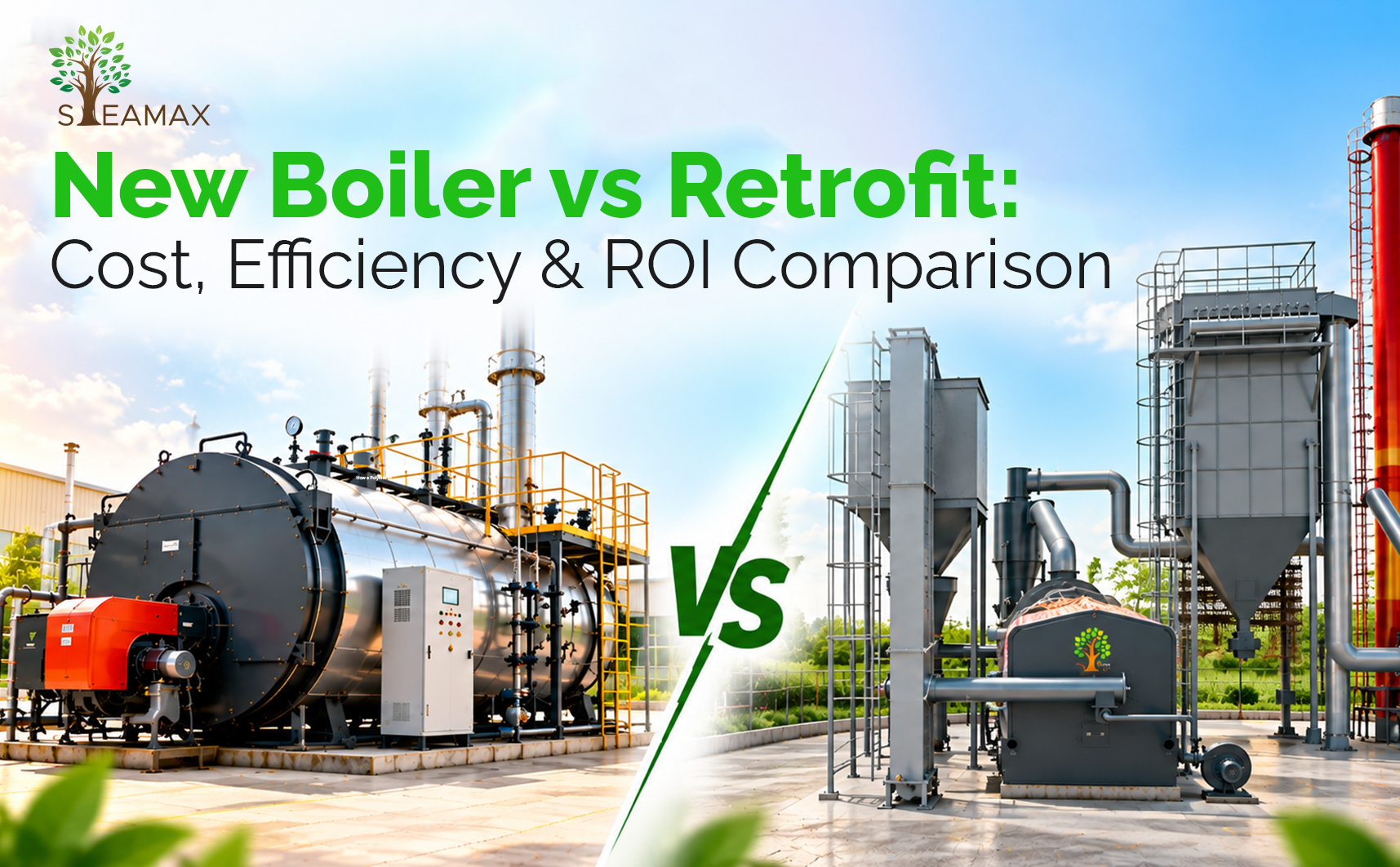
New Biomass Boiler vs. Oil to Biomass Retrofit Kit
| Factor | New Biomass Boiler | Steamax OBR Kit |
|---|---|---|
| Initial Investment | Requires purchasing and installing a new boiler | May reduce investment by retrofitting a suitable existing oil-fired boiler |
| Installation | May require extensive installation work | Modifies the existing system, depending on suitability |
| Downtime | Depends on installation and commissioning | Depends on retrofit requirements |
| Fuel | Biomass fuel specified for the new boiler | Biomass fuel compatible with the converted system |
| Fuel Feeding | Requires a suitable feeding system | Includes automated fuel feeding |
| Ash Handling | Depends on the boiler design | Includes an automated ash-removal system |
| Operating Costs | Depend on fuel prices, efficiency, and maintenance | Depend on biomass costs, system performance, and maintenance |
| Best For | Facilities needing a new boiler | Facilities with a suitable existing oil-fired boiler |
Modernize Your Industrial Heating System With Steamax
Fossil fuel boilers have supported industrial production for decades, but fuel-price uncertainty, emissions requirements, and operating costs are encouraging businesses to evaluate alternatives.
For suitable installations, Steamax’s Oil to Biomass Retrofit Kit may offer a practical way to explore biomass heating without automatically replacing the entire boiler. Automated fuel feeding, ash handling, and a site-specific conversion plan can help address important operational challenges.
Ready to explore an oil-to-biomass conversion for your facility?
Contact Steamax at +91 93151 24803 or visit the page Oil-to-Biomass Retrofit Kit (OBR).

8 Comments
Very nice write-up. I definitely appreciate this site. Thanks!
Thank you for your feedback.
I must thank you for the efforts youve put in penning this site. I am hoping to check out the same high-grade blog posts by you in the future as well. In fact, your creative writing abilities has motivated me to get my very own blog now 😉
Thanks for feedback.
I was excited to discover this website. I want to to thank you for your time for this wonderful read!! I definitely liked every part of it and i also have you book-marked to look at new things on your website.
Hello there! I simply wish to offer a big thumbs up for the terrific details you have right here on this article. I will be coming back to your blog for more soon.
https://main7.top/
Thanks
THANKS