
Summary: This article explains the key compliance considerations for industries in the National Capital Region (NCR), compares gas-fired boilers with biomass retrofits, and outlines how Steamax’s Oil-to-Biomass Retrofit Kit can support a fuel transition.
Industrial emissions are an important concern in the National Capital Region (NCR), where poor air quality can affect public health and business operations. The Commission for Air Quality Management (CAQM) issues directions to address pollution, including requirements concerning industrial fuels and emissions.
Biomass may be an option for eligible industrial facilities where applicable directions permit its use. However, businesses must verify the latest CAQM directions, state pollution control board requirements, and deadlines before changing fuels.
For industries looking to move away from conventional fuels without replacing an entire boiler, Steamax’s Oil-to-Biomass Retrofit (OBR) Kit offers a potential alternative.
CAQM Requirements: What Should NCR Industries Check?
Before switching to biomass, industries should review the requirements that apply to their location, industry category, boiler, and fuel type.
Key considerations include:
- Permitted fuels: Confirm whether biomass is permitted for your specific facility and application under the latest applicable CAQM directions.
- Emission limits: Check the particulate matter and other emission limits applicable to your equipment. Don’t assume a single limit applies to every biomass boiler.
- Consent to Operate (CTO): Consult the relevant State Pollution Control Board or Pollution Control Committee to establish whether a fresh or amended consent is required.
- Compliance deadlines: Verify the current implementation dates and any exemptions or conditions.
- Non-compliance: Failure to meet applicable directions can lead to regulatory action, including closure where legally ordered.
The original article cited particulate matter limits of 80 mg/Nm³, with 50 mg/Nm³ as a preferred target. These figures should be checked against the latest official requirements for the specific boiler and installation before being relied upon.
For official information, consult the Commission for Air Quality Management and the relevant state pollution control board.
Is Biomass a Long-Term Alternative to PNG?
Industries use piped natural gas (PNG) as a fuel option, while biomass offers another route for facilities permitted to use it.
The long-term suitability of biomass depends on several factors:
- Fuel availability: A reliable supply of consistent-quality biomass is essential.
- Operating costs: Delivered fuel prices, moisture, calorific value, transport, and combustion efficiency all affect the actual cost of heat.
- Emissions performance: Biomass combustion can produce particulate matter and other emissions. Suitable equipment, proper operation, and pollution controls remain necessary.
- Regulatory stability: Industries should monitor official directions rather than assume that current fuel permissions or deadlines will remain unchanged.
Biomass can reduce dependence on fossil fuels, but it isn’t automatically pollution-free or carbon-neutral in every application.
Should Gas- or Oil-Fired Boiler Users Switch to Biomass?
Biomass may offer cost advantages for some industrial users, particularly where suitable fuel is readily available. However, installing a new biomass boiler can require substantial capital investment, engineering work, and production downtime.
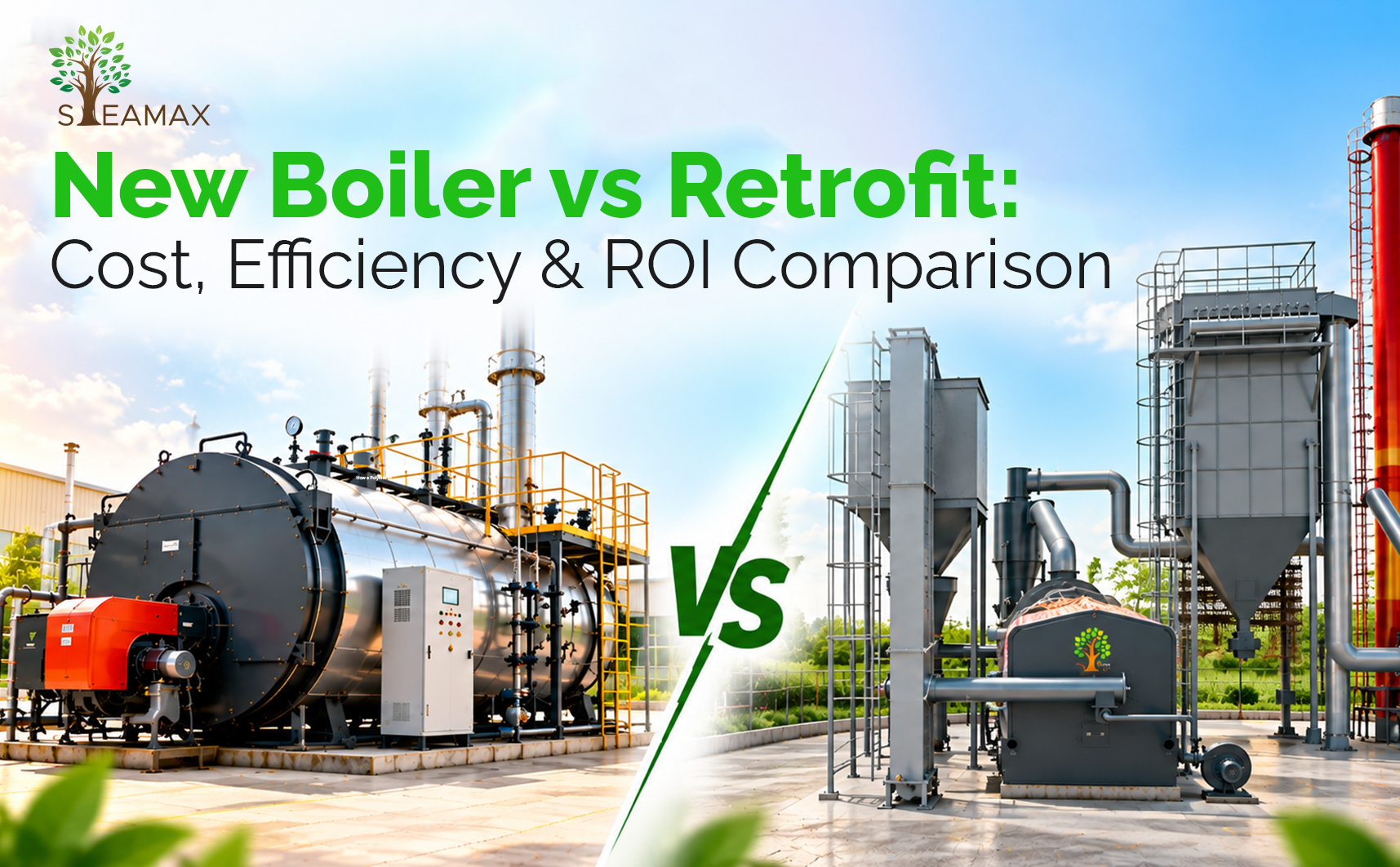
An alternative is to assess whether the existing boiler can be converted using a retrofit system.

Steamax’s OBR Kit: A Retrofit Option for Industries
Steamax’s Oil-to-Biomass Retrofit Kit is designed to adapt suitable existing fossil-fuel-fired boilers for biomass combustion.
Its potential benefits include:
- Lower initial investment: Retrofitting may cost less than installing a completely new boiler, depending on the existing equipment and project scope.
- Automated fuel feeding: A mechanical feeding system supplies biomass to the combustion chamber, reducing manual fuel handling.
- Ash management: Biomass ash requires appropriate removal and disposal arrangements.
- Fuel flexibility: Depending on the system configuration, the installation may allow switching between biomass and conventional fuels.
- Potential fuel savings: Biomass may reduce fuel costs when its delivered cost per unit of useful heat is lower than that of the existing fuel.
Steamax has cited potential fuel-cost savings of 40–50% and retrofit costs below 50% of the cost of a new boiler in its promotional material. These are not guaranteed results; actual savings depend on fuel prices, boiler performance, operating conditions, and installation costs.
Any fuel changeover must follow the equipment manufacturer’s procedures and applicable regulatory requirements.
| Parameter | Gas Boiler | OBR Kit |
| Fuel Flexibility | No. Can only use fossils fuels | Yes. User can shift between biomass & gas or oil within few hours |
| CAPEX | High | Low (<50% of the new boiler) |
| Cost savings | May or may not save | Upto 50% |
| Efficiency | 75-80% | 75-80% |
Explore Steamax's OBR Kit
For eligible industrial facilities, converting an existing boiler to biomass can diversify fuel supply and manage operating costs without installing a new boiler. Steamax's OBR Kit is one option to evaluate, but the right solution depends on your equipment, fuel availability, emissions requirements, and regulatory permissions.
Contact Steamax
Phone: +91 93151 24803
Email: info@steamaxindia.com
Product details: Steamax OBR Retrofit Kit