The Science of Combustion: Calorific Value & Fuel Efficiency

In this blog:

  • Calorific value is the heat a fuel releases when burned, measured in kcal/kg (or kcal/SCM for gas); the higher it is, the less fuel the boiler needs per tonne of steam.
  • GCV vs NCV: gross calorific value includes heat from condensing water vapour, net does not. Always compare fuels on the same basis.
  • Typical values: furnace oil 9,500 to 10,000 kcal/kg, coal 4,500 to 6,000, and biomass 3,000 to 4,500, with moisture and ash pulling biomass values down.
  • Compare cost per tonne of steam, not price per kg: combine calorific value, boiler efficiency, fuel price and ash disposal. In our example, Astillas costs about 47% less per tonne of steam than PNG.
  • Astillas by Steamax delivers 4,200 to 4,500 kcal/kg, with ash below 3% and a steady supply year-round, cutting fuel costs by 30 to 50% versus oil and gas.

Many plants buy fuel by the kilogram or tonne. A cheaper fuel looks like a saving until the boiler burns more of it, the operators feed it by hand, and the ash pit fills twice as fast.

Calorific value is the number that explains why. This guide explains what actually happens when fuel burns, where efficiency is lost, the difference between GCV and NCV, typical values for common industrial fuels, and a simple method to calculate what each fuel really costs your plant.

What Is Calorific Value? GCV vs NCV Explained

Calorific value is the energy a fuel releases per unit mass or volume. Gross calorific value (GCV) counts all the heat, including the heat recovered by condensing water vapour; net calorific value (NCV) excludes it, so NCV is always lower and closer to what a boiler actually uses.

Calorific value is measured in a bomb calorimeter and reported in:

  • kcal/kg for solid fuels such as coal and biomass
  • kcal/litre or kcal/kg for liquid fuels such as furnace oil and diesel
  • kcal/SCM for gases such as natural gas (PNG)

One kilocalorie equals 4.184 kilojoules, so 4,430 kcal/kg is about 18.5 MJ/kg.

Gross calorific value (GCV), also called higher heating value, assumes the water formed during combustion condenses and gives back its heat.

Net calorific value (NCV), or lower heating value, assumes that water leaves the stack as vapour, as it does in most industrial boilers. The gap between GCV and NCV grows with the fuel’s moisture and hydrogen content, which is why it matters more for biomass than for coal.

Why is the Calorific Value of Fuel Important?

Calorific value determines how much fuel you buy, move, store, feed, and burn to produce a tonne of steam, and it shapes your ash load and boiler performance.

    1. Fuel consumption and cost. A fuel with higher calorific value delivers more heat per kilogram, so the boiler burns less of it. A cheap fuel with low calorific value can end up costing more per tonne of steam.
    2. Handling and storage. Less fuel per tonne of steam means fewer trucks, a smaller fuel yard and less labour at the feed point.
    3. Steady combustion. Fuels with consistent calorific value keep steam pressure stable. Fuels that swing with the season, such as wet husk or mixed briquettes, cause pressure dips and force operators to overfire.
    4. Ash and emissions. Low-calorific fuels are often high in ash. More ash means more clinker on the grate, more fly ash for the pollution control system, and higher disposal costs.
    5. Fuel selection. Comparing calorific value, moisture and ash together is how you compare biomass fuels properly and pick one that suits your boiler.

Typical Calorific Values of Biomass Fuels

Fossil fuels carry two to three times more heat per kilogram than biomass, but biomass costs far less per unit of heat. Among biomass fuels, calorific value ranges from about 3,000 to 4,500 kcal/kg depending on the fuel, its moisture and its ash.

How to Calculate Your Real Fuel Cost per Tonne of Steam

Divide the heat needed for one tonne of steam (about 6.3 lakh kcal) by the fuel’s calorific value and your boiler efficiency, then multiply by the fuel price.

The formula

Fuel cost per tonne of steam = (6,30,000 kcal ÷ (calorific value × boiler efficiency)) × fuel price

Step by step

  1. Get the calorific value of the lot you buy, from a lab report, in the same units you pay in (per kg, litre or SCM).
  2. Use a realistic boiler efficiency, for example about 85% for oil and gas boilers and about 75% for biomass boilers.
  3. Work out the fuel needed for one tonne of steam: 6,30,000 ÷ (calorific value × efficiency).
  4. Multiply by your landed price of the fuel, including transport.
  5. For solid fuels, add ash disposal: fuel used × ash % × your disposal cost per tonne of ash.

Worked example: PNG vs Astillas (example prices)
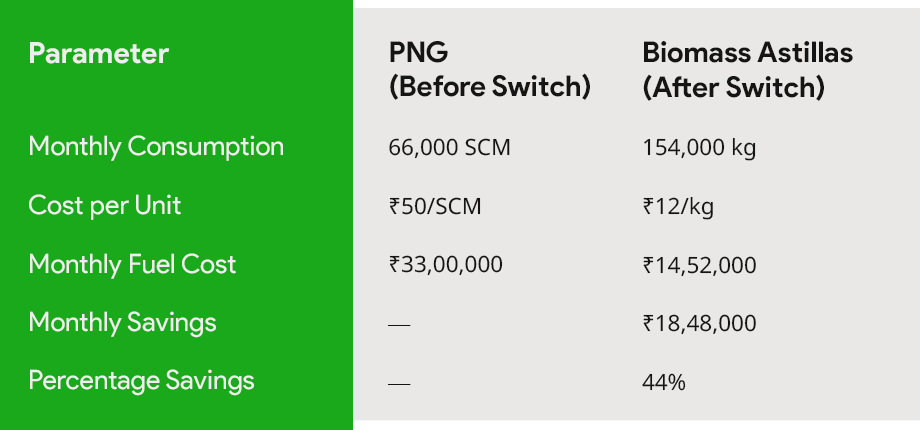
Comparison table: Left green column with Parameters; right columns show Before Switch (PNG) vs After Switch (Biomass Astillas): Monthly Consumption 66,000 SCM vs 154,000 kg; Cost per Unit ₹50/SCM vs ₹12/kg; Monthly Fuel Cost ₹33,00,000 vs ₹14,52,000; Monthly Savings and Percentage Savings (44%).

In this example, Astillas reduce fuel cost by about 44% , even though the boiler burns more than twice the weight of fuel. That is why calorific value and price must always be read together.

You can run this comparison for coal, furnace oil, diesel, PNG and four biomass fuels with your own prices on the Astillas fuel cost calculator.

Astillas: High Calorific Value Biomass Fuel by Steamax

Astillas is Steamax’s proprietary biomass fuel made from cashew de-oiled shell blended with sawdust and wood chips. It delivers 4,200 to 4,500 kcal/kg with ash below 3% and moisture below 10%, and its supply does not depend on a harvest.

  • High calorific value: 4,200 to 4,500 kcal/kg, higher than pellets, briquettes and rice husk. A recent lab test measured a GCV of 4,430 kcal/kg.
  • Low ash and moisture: ash below 3% (2.16% in the lab test) and moisture below 10%, so less clinker, less fly ash and a smaller disposal bill.
  • Low sulphur and nitrogen: 0.07% sulphur and 0.35% nitrogen keep SOx and NOx low. With a pulse jet bag filter, particulate matter stays below 50 mg/Nm³.
  • Steady all year: its main ingredient is an industrial by-product of cashew processing, so quality and supply do not swing with the monsoon.
  • Built for automatic feeding: small, uniform pieces flow through hoppers and screw feeders. Plants still feeding briquettes by hand can add automatic fuel feeding.
  • Lower fuel cost than oil and gas: typically 30 to 50% lower.

Straight talk: per tonne of steam, coal is still cheaper than Astillas. Astillas makes sense over coal when you need less dust and ash, lower sulphur, a fossil-free fuel, automatic feeding, or where coal use is restricted.

Results from plants that switched

  • A pharma plant in Roorkee moved from LDO to Astillas after converting its boiler with the OBR kit, cutting fuel cost by 52%, a saving of ₹93.6 lakh a year.
  • A packaging plant in Kashipur moved a thermic fluid heater from PNG to Astillas, cutting fuel cost by 44%, about ₹1.74 crore a year.
  • A food processing plant in Karnataka moved from hand-fed briquettes to Astillas with automatic feeding. Astillas costs more per kilogram there, but the plant burns a third less fuel and saved 15.8%.
Frequently Asked Questions

A fuel's calorific value sets how much heat is available; combustion efficiency decides how much of it is released and captured. Low-calorific fuels are usually wetter and higher in ash, so more heat goes into evaporating moisture and more carbon stays unburnt in the ash, lowering boiler efficiency.

It is the amount of heat released when a unit of fuel burns completely, measured in kcal/kg, kJ/kg or kcal/SCM for gases. The higher the calorific value, the less fuel a boiler needs to make the same amount of steam.


Gross calorific value (GCV) includes the heat recovered when water vapour in the flue gas condenses; net calorific value (NCV) excludes it. Industrial boilers do not usually recover that heat, so NCV is closer to usable heat. Compare fuels on the same basis.


Among common Indian biomass fuels, Astillas (4,200 to 4,500 kcal/kg) and pellets (3,800 to 4,200 kcal/kg) are at the top, ahead of briquettes (3,000 to 4,000 kcal/kg) and rice husk (about 3,200 kcal/kg). Moisture and ash in the actual lot matter as much as the headline figure.

No. Furnace oil has more than twice the calorific value of biomass but usually costs much more per tonne of steam. Compare fuels on cost per tonne of steam, using calorific value, boiler efficiency, price and ash disposal together.


About 6.3 lakh kcal of heat. At 75% boiler efficiency that is roughly 190 kg of Astillas; at 85% efficiency it is about 86 SCM of natural gas. Actual figures depend on steam pressure, feedwater temperature and boiler condition.

An oil or gas boiler first needs a biomass combustion system. Steamax's OBR kit converts existing oil, gas or coal-fired boilers and thermic fluid heaters to run on biomass fuels such as Astillas.


Is Your Fuel Up to the Mark?

If your boiler or heater is burning more fuel than it should, struggling with ash and clinker, or running on costly oil or gas, start by comparing your fuels on cost per tonne of steam. Then talk to us.

Request a fuel sample and price for Astillas, or call +91-9315124803.

Sources

Share this article

Clean. Green. Efficient.

We help industries shift to green biomass fuel and cut their emissions and fuel costs.

Green steam and heat for Indian industry.