

As India shifts towards decarbonization and sustainable energy, industries are under increasing pressure to move away from fossil fuels. Biomass energy has quickly emerged as a reliable and cost-effective solution for industrial heating and power needs.
However, one major decision that businesses must make is about the financing model:
Should they invest upfront through CAPEX, or adopt an OPEX (BOOT) model where they pay per unit of energy?
Choosing the right model can impact your immediate costs, long-term operational efficiency, and sustainability targets.
Understanding the Financial Models: CAPEX vs. OPEX
What is CAPEX?
CAPEX stands for Capital Expenditure. In this model:
- The company makes the full upfront investment to buy and install the biomass system.
- Ownership of the system lies entirely with the company.
- The company is responsible for operation, maintenance, and performance.
- It is seen as a long-term asset on the company’s balance sheet.
What is OPEX / BOOT (Build-Own-Operate-Transfer)?
OPEX refers to operational expenditure, and BOOT (Build-owned-operate transfer) is a popular model. Here:
- A service provider invests, builds, and operates the biomass system at the client’s site.
- The client pays only for the energy consumed—whether steam, heat, or power.
- There is minimal or zero upfront cost for the client.
- Ownership and maintenance responsibilities remain with the service provider.
When Should You Choose CAPEX?
The CAPEX model works best if your company:
- It has substantial cash reserves and can absorb upfront investments.
- Has a long-term site commitment (at least 10–15 years).
- Possesses internal technical expertise for O&M (operation and maintenance).
- Prefers owning assets and fully controlling operations.
Examples:
- Large Industrial Players:
- FMCG giants like ITC and Hindustan Unilever and pharma leaders like Sun Pharma and Dr Reddy often opt for CAPEX in plants with predictable, long-term operations.
- Infrastructure-Heavy Industries: Large cement manufacturers like UltraTech Cement or ACC, and steel or chemical plants with multi-decade life cycles.
- Corporates Focused on Long-Term Asset Building: Companies with ESG goals integrated into their core investment planning choose to build green energy infrastructure as a strategic asset.
When Should You Choose OPEX / BOOT?
OPEX models make sense if your company:
- Wants to avoid heavy initial investments.
- Needs quick project execution and immediate energy savings.
- Focuses on core operations, not energy management.
- Prefers operational cost predictability without surprises.
Examples:
- Small and Medium Enterprises (SMEs): Textile units, food processors, automotive ancillaries, and small foundries.
- Large Corporates and MNCs: Companies like Unilever, Coca-Cola, PepsiCo (Varun Beverages), and Nestlé have adopted BOOT/OPEX models in various regions to decarbonize operations without diverting capital from core business functions.
- Industrial Clusters and SEZs: Facilities operating under tight budget controls but aiming for ESG compliance and long-term energy cost reductions.
Key Factors to Consider Before Choosing CAPEX or OPEX
- Financial Flexibility: Assess your capital vs. operational budget allocations and ROI expectations.
- Strategic Control Needs: Decide whether asset ownership and in-house control align with your long-term strategy.
- Risk Appetite: Evaluate your willingness to take on performance, fuel, and technology risks.
- Internal Capabilities: Consider if your team can manage energy systems or prefers outsourcing to specialists.
- Procurement Cycle Alignment: Match the model with your approval hierarchies, tendering processes, and investment cycles.
- Sustainability Commitments: Factor in ESG targets, carbon neutrality goals, and regulatory compliance pressure
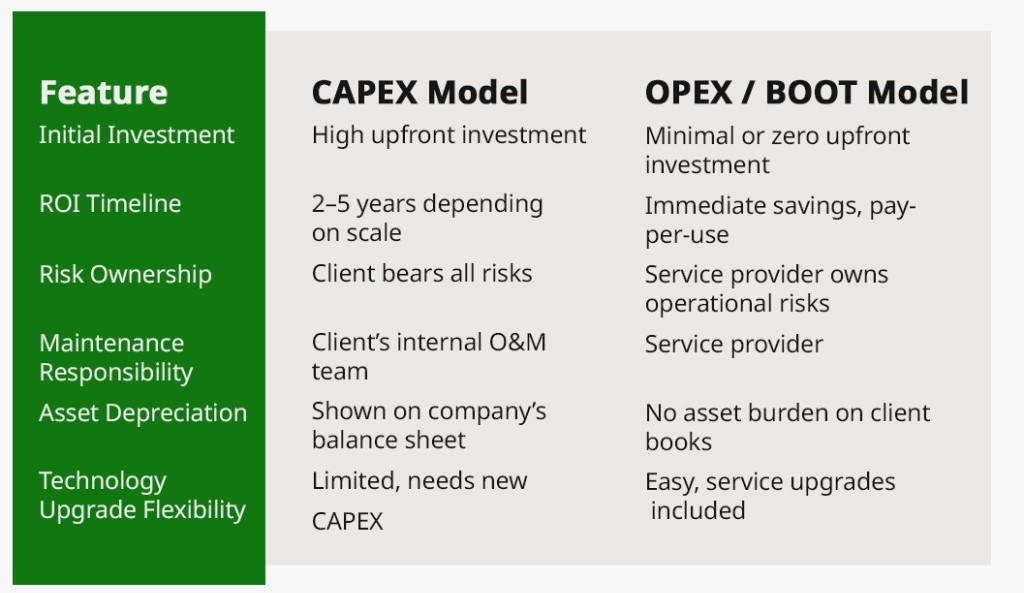
Steamax’s SAAS/BOOT Model
Steamax offers industries a modern way to adopt biomass energy through its SAAS (Steam as a Service) model based on the BOOT (Build-Own-Operate-Transfer) principle. Instead of investing heavily upfront, industries can pay for the energy (steam or heat) they use, while Steamax takes full responsibility for building, owning, operating, and maintaining the biomass system.
- SAAS (Steam as a Service) Model: Pay only for the energy consumed—no need to own the system.
- BOOT Framework: Steamax builds, owns, operates, and maintains the biomass plant.
- Zero Upfront Investment: No capital expenditure is required from the client.
- Guaranteed Performance: Steamax ensures consistent energy delivery and system efficiency.
- Risk-Free Operations: Steamax handles all maintenance, repairs, and upgrades.
- Ideal for: Industries seeking fast energy transition, operational cost savings, and sustainability without financial stress.
Conclusion: Choose What Fits Your Business Best
There’s no “one-size-fits-all” answer.
Both CAPEX and OPEX models can lead you toward cleaner energy, better savings, and carbon footprint reduction. The real choice depends on your business context, financial strategy, and growth vision. Biomass is the future—whether you own it or pay for it, it is essential to make the shift.
We need a cogen unit using deoiled Cashew shell( undeoiled cashew shell if possible)
to produce LP steam between 6 to 8 bar for process and power to run our operations with facility to vary the power load when the demand falls down
Boiler 12 TPH, 25 bar, 400°C, solid fuel-fired
Fuel Deoiled cashew shell, ~2.6 TPH
Turbine 1.2 MW backpressure
Generator 1.2 MWe, 415 V or 11 kV
Process steam 4,800 kg/hr @ 4–6 bar (for cooking only)
Electric dryers Powered by turbine output (300–400 kW)
power to process 400 to 600 KW
Hi, for more information please connect at info@orangered-antelope-537718.hostingersite.com