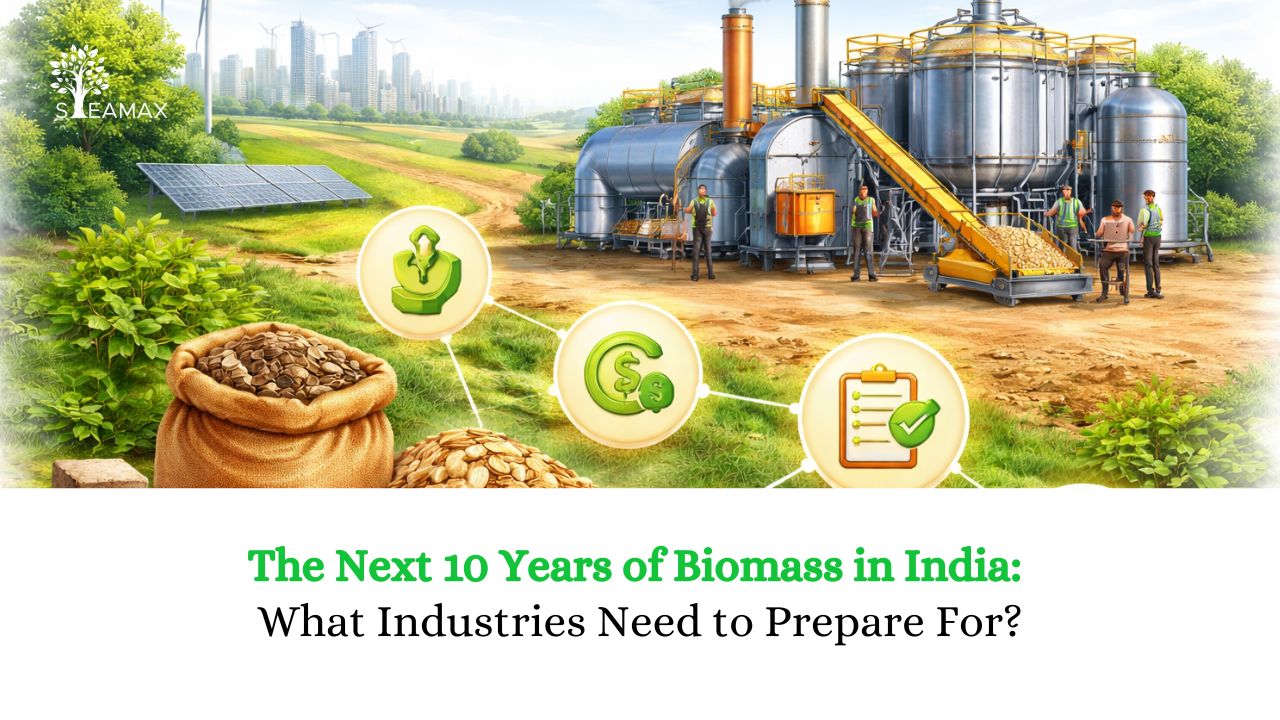
For a long time, biomass in India was seen as a secondary fuel—used when coal or oil became expensive or unavailable. That perception is changing quickly. Today, biomass is no longer just an “alternative.” It is becoming a strategic energy choice for industries looking to balance cost, compliance, and long-term sustainability.
Over the next 10 years, biomass in India is expected to move from scattered adoption to structured, large-scale industrial integration. And this shift will be driven largely by process industries, manufacturing units, and MSMEs.
Why Biomass Adoption Is Accelerating in Industry
Several factors are pushing industries toward biomass:
- Rising and volatile fossil fuel prices
- Increasing environmental regulations
- Pressure from global supply chains for cleaner production
- Need for cost predictability in steam and heat generation
Unlike imported fuels, biomass offers local availability and relative price stability, making it attractive for industries that rely heavily on thermal energy.
In sectors such as food processing, textiles, chemicals, ceramics, and pharmaceuticals, biomass is increasingly being incorporated into long-term energy planning.

Shift from Raw Biomass to Engineered Fuels
The next decade will not just see more biomass usage—it will see better biomass usage.
Industries are gradually moving from raw agricultural waste to engineered biomass fuels, such as:
- Briquettes
- Pellets
- Processed agro-residues
- Custom fuel blends designed for specific boilers
This shift improves:
- Combustion efficiency
- Fuel consistency
- Handling and storage
- Emission control
As fuel quality improves, biomass systems become more predictable and easier to operate at scale.
Rise of Retrofitting in Existing Industrial Boilers
One of the biggest growth drivers will be retrofitting existing fossil-fuel boilers.
Instead of replacing entire systems, industries are increasingly:
- Converting oil- and coal-fired boilers to biomass
- Adopting multi-fuel combustion systems
- Upgrading feeding and combustion mechanisms
This approach reduces capital investment while allowing plants to transition toward cleaner energy.
Over the next decade, retrofit-based adoption is expected to dominate, especially in medium-scale industries and MSMEs.
Focus on Combustion Efficiency and Automation
Simply switching to biomass is not enough. Efficiency will become the defining factor.
The new biomass systems will focus on:
- Automated fuel feeding systems
- Controlled air–fuel ratios
- Real-time combustion monitoring
- Reduced clinker formation and ash handling issues
As technology improves, biomass boilers will become more stable, less operator-dependent, and more efficient.
This is critical for industries where a consistent steam supply directly affects production.
Stronger Compliance and Emission Control Requirements
Environmental norms in India are tightening, and this trend will continue.
Industries using biomass will need to ensure:
- Proper particulate control (bag filters, ESPs)
- Monitoring of emissions
- Compliance with state pollution control boards
The next decade will likely see more adoption of:
- Continuous emission monitoring systems (CEMS)
- Advanced filtration systems
- Integrated compliance solutions
Biomass will increasingly be seen not just as a fuel, but as part of a complete compliance-ready energy system.
Development of Local Biomass Supply Chains
One of the most important changes will happen outside the factory—in the fuel supply ecosystem.
India has abundant agricultural residue, but the challenge has always been:
- Collection
- Processing
- Transportation
- Consistent supply
Over the next 10 years, we can expect:
- Organised biomass aggregation networks
- Regional fuel hubs
- Digital platforms for biomass sourcing
- Better logistics and storage infrastructure
This will make biomass more reliable and scalable for industrial use.
Cost Stability Will Drive Long-Term Adoption
Industries are no longer just looking for the cheapest fuel—they are looking for predictable energy costs.
Biomass offers:
- Lower exposure to global price fluctuations
- Better long-term contracts
- Reduced dependency on imports
As global energy markets remain uncertain, this cost stability will become one of the strongest reasons for biomass adoption.
Challenges That Still Need Attention
Despite strong growth potential, a few challenges remain:
- Fuel quality inconsistency in some regions
- Storage and handling issues
- Initial investment for system upgrades
- Need for skilled operation and maintenance
However, these challenges are gradually being addressed through technology, better fuel engineering, and structured supply chains.
What biomass in Next Decade Really Means
The future of biomass in India is not about replacing one fuel with another. It is about rethinking how industries generate and manage thermal energy.
Over the next 10 years, biomass will:
- Become a mainstream industrial fuel
- Integrate with advanced combustion systems
- Support both cost reduction and compliance goals
- Strengthen local energy ecosystems
To explore how biomass solutions can fit into your industrial operations, visit: https://steamaxindia.com/