When industries select an Air Pollution Control Device (APCD), one of the first technical questions engineers ask is simple: How much gas is actually moving through the system? The volumetric gas flow rate determines the size, design complexity, energy consumption, and even the economic feasibility of pollution control equipment. A system that performs efficiently at a small industrial plant may become impractical when the gas volume increases several times.
In practical terms, gas flow rate represents the total exhaust gas volume generated by a process per hour, usually measured in cubic meters per hour (m³/h). Boilers, furnaces, reactors, and kilns all produce flue gas, and the larger the process, the larger the gas flow that must be treated before release into the atmosphere.
Typical Gas Flow Ranges in Industrial Systems
Different industrial processes generate different gas volumes. Small and medium industrial units—such as food processing plants, textile units, biomass boilers, and chemical processing systems—typically produce exhaust flows ranging from 5,000 to 200,000 m³/h. Within this range, technologies such as bag filters and wet scrubbers operate effectively and economically.
However, large-scale operations such as power plants, large furnaces, and heavy industrial boilers may generate exhaust streams ranging from 300,000 to 1,000,000 m³/h. At these scales, the choice of pollution control equipment becomes more challenging because both energy consumption and equipment size increase significantly.
How Gas Flow Rate Influences APCD Choice
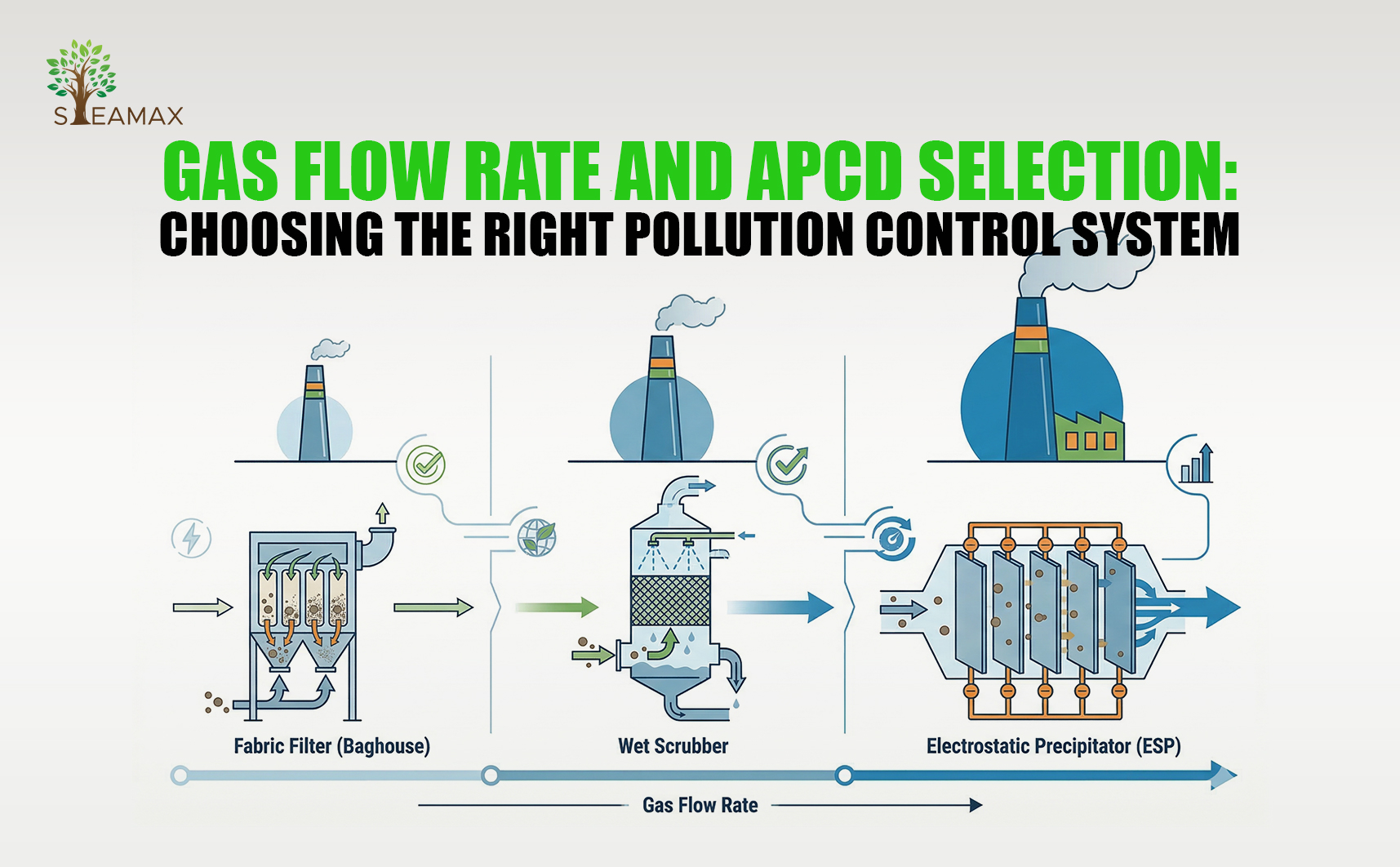
Each air pollution control technology has a practical operating range where it performs most efficiently. When gas flow moves beyond that range, the system either becomes inefficient or extremely expensive to operate.
Wet Scrubbers
Wet scrubbers generally work best in moderate gas-flow systems.
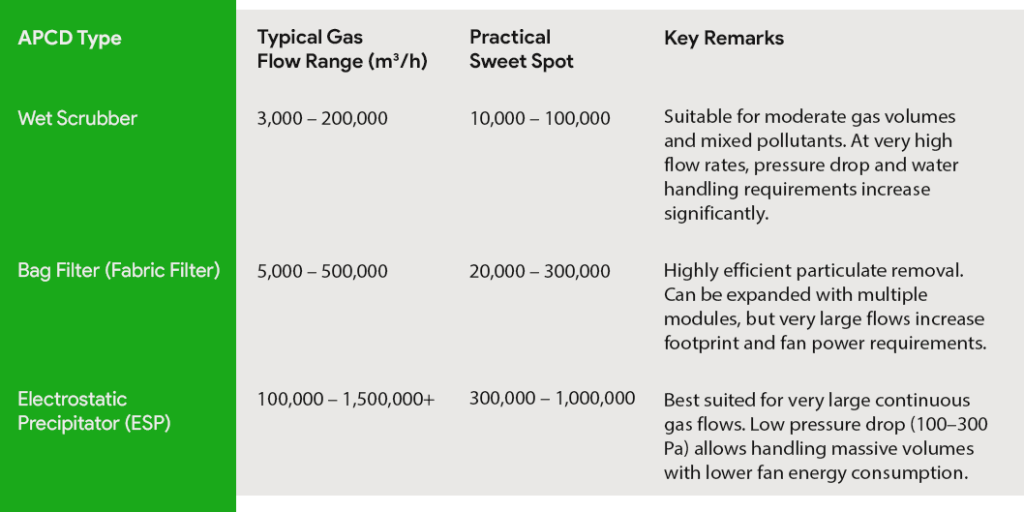
- Typical operating range: 3,000 – 200,000 m³/h
- Optimal range: 10,000 – 100,000 m³/h
At these flow rates, wet scrubbers can effectively remove both particulate matter and certain gaseous pollutants through gas–liquid contact. However, as gas volume increases, the system requires larger pumps, higher water circulation, and stronger fans to overcome pressure drop. It increases both energy consumption and water-handling requirements.
For extremely large gas streams along with SOx and NOx , wet scrubbers may still be used, but the operating cost and equipment footprint increase significantly.
Bag Filters (Fabric Filters)
Bag filters are among the most versatile APCDs and can handle a wider range of gas volumes.
- Typical operating range: 5,000 – 500,000 m³/h
- Optimal range: 20,000 – 300,000 m³/h
Their modular design allows additional filter compartments to be added as gas flow increases. They are suitable for many industrial boilers and process plants.
However, scaling a bag filter to very large capacities increases the number of filter bags, compressed air consumption, and structural footprint. At extremely high gas volumes, fan power requirements and maintenance complexity can become significant operational concerns.
Electrostatic Precipitators (ESPs)
When gas flow becomes extremely large, Electrostatic Precipitators (ESPs) are often the preferred solution.
- Typical operating range: 100,000 – 1,500,000+ m³/h
- Optimal range: 300,000 – 1,000,000 m³/h
ESPs are design for high-volume continuous operation, which is why they are widely use in power plants and large industrial facilities.
The modular design of ESP fields allows engineers to expand the system while maintaining stable performance, making it highly suitable for large-scale industrial emission control.
Key Takeaway
Gas flow rate is one of the most important engineering parameters when selecting an air pollution control system.
- Wet scrubbers work best for moderate gas volumes.
- Bag filters provide flexibility across medium to high flows.
- Electrostatic precipitators become the most practical solution for extremely large industrial gas streams.
Understanding the scale of the exhaust system ensures that the chosen APCD delivers consistent emission control, manageable operating costs, and long-term reliability.