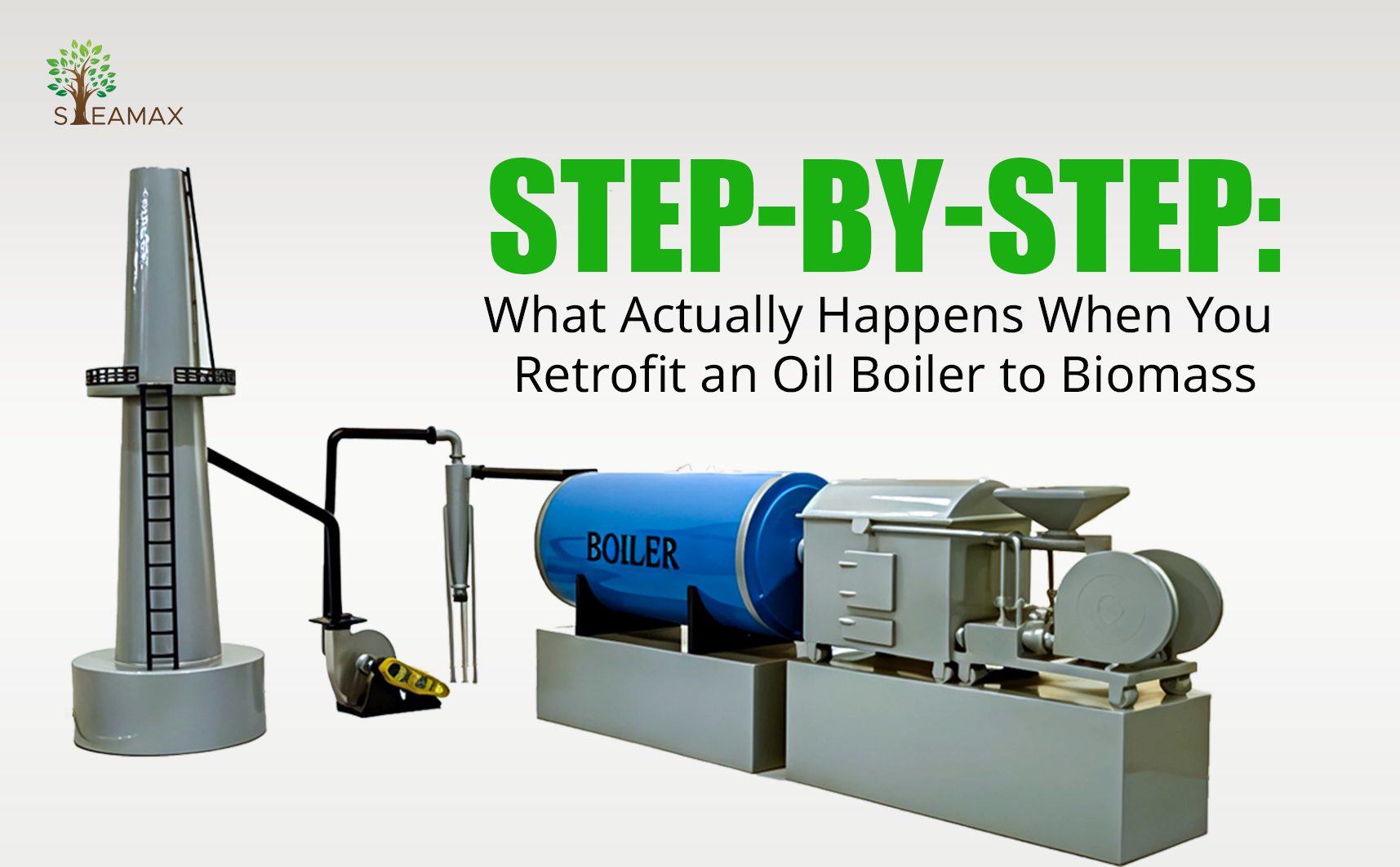
Most plants must know that they should switch from furnace oil, LDO, or LSHS to biomass — the economics make it obvious. But what’s not apparent is the actual process. What really happens inside your boiler house when you decide to retrofit? How much time does it take? Which parts get replaced, and which stay precisely the same?
There’s a lot of confusion around this, especially for plants that have been running on oil for 10–15 years without ever touching the boiler setup.
So instead of giving you generic technical jargon, let’s break down the real, on-ground process.

1. The First Reality Check: Understanding Whether Your Boiler Can Be Retrofitted
“Is your existing oil boiler structurally healthy enough to take biomass?”
This is where a site audit comes in.
Teams look at:
- Shell thickness
- Furnace condition
- Refractory status
- Tubes and passes
- Space availability around the boiler
2. Mapping the Fuel Change: From Liquid to Solid
Oil burns easily when atomized. Biomass doesn’t.
So the real engineering challenge lies in creating the right combustion environment for solid fuel.
This is where Steamax’s retrofit kits come in, like the OBR Series and OBR Lite. These systems rebuild the front end of your oil boiler while keeping its pressure body intact.
Key changes include:
- Turning the oil-fired furnace front into a re-engineered solid fuel firing.
- Building a combustion bed or grate
- Optimizing air distribution for pellets, briquettes, or astillas
- Reshaping the flame path to suit solid fuel
3. The Foundation of the Retrofit: Installing the Biomass Combustion System
Once the design is approved, the real work begins.
This involves:
Building the Fire Bed / Grate Area
This becomes the heart of the conversion. Engineers design a grate suitable for your chosen biomass — pellets, briquettes, or shredded agro-waste.
Secondary & Primary Air System
Oil boilers don’t need this split-air approach, but biomass does.
This ensures:
- Complete combustion
- Higher efficiency
- Lower unburnt losses
Ash Handling Setup
Oil boilers never had this. Biomass produces ash, so a proper ash discharge and disposal path is installed.
It is where most plants realize: “Retrofitting isn’t complicated — it’s just thoughtful engineering.”
4. Automating the Fuel Supply: No More Manual Feeding
Steamax’s Auto Fuel Feeding System (AFK) ensures consistent fuel flow without operator intervention.
The setup includes:
- Fuel storage hopper
- Screw or belt conveyors
- Rotary valves
Why automation matters?
Biomass needs steady, predictable feed rates to generate stable steam. Manual feeding leads to fluctuating temperatures and pressure dips — no plant wants that.
5. The Critical Step: Converting Your Flue Gas Path for Solid Fuel
Biomass produces different flue gas characteristics compared to oil:
- Higher particulate matter
- Slightly lower flame temperature
- Different flow resistance
The conversion includes:
- Optimizing the draught system
- Re-calibrating ID/FD fans
- Ensuring proper furnace residence time
This ensures your boiler continues to transfer heat efficiently even after the fuel switch.
6. Adding the Mandatory Component: Pollution Control System
Oil-fired boilers often don’t have bag filters because oil burns relatively clean. But biomass is a particulate-heavy fuel.
So, to meet emission norms, a bag filter system is essential.
Steamax integrates a:
- Cyclone (for pre-separation)
- Bag filter
- Emission monitoring setup
This ensures your emissions comfortably meet state PCB norms.
7. Training Your Team: Because Operators Matter
A retrofit is only as good as the people running the boiler.
Steamax trains operators on:
- Biomass characteristics
- Feeding control
- Ash management
- Start/stop sequences
- Bag filter cleaning cycles
This ensures your team feels at home with the new system from day one.
9. What Changes for the Plant? (The Real-World Outcome)
Once the retrofit is live:
- Steam quality stays the same
- Pressure stability improves due to automation
- Fuel cost drops by 30–50%
- Daily operating habits change
- Emissions stay compliant with PCB standards
Final Word: Retrofit is a Strategy
Switching from oil to biomass isn’t just about saving money
It’s about:
- Energy independence
- Reducing carbon footprint
- Meeting ESG & compliance goals
- Preparing your Plant for the next decade
If you’re considering a switch, explore Steamax’s retrofit solutions here: https://steamaxindia.com/