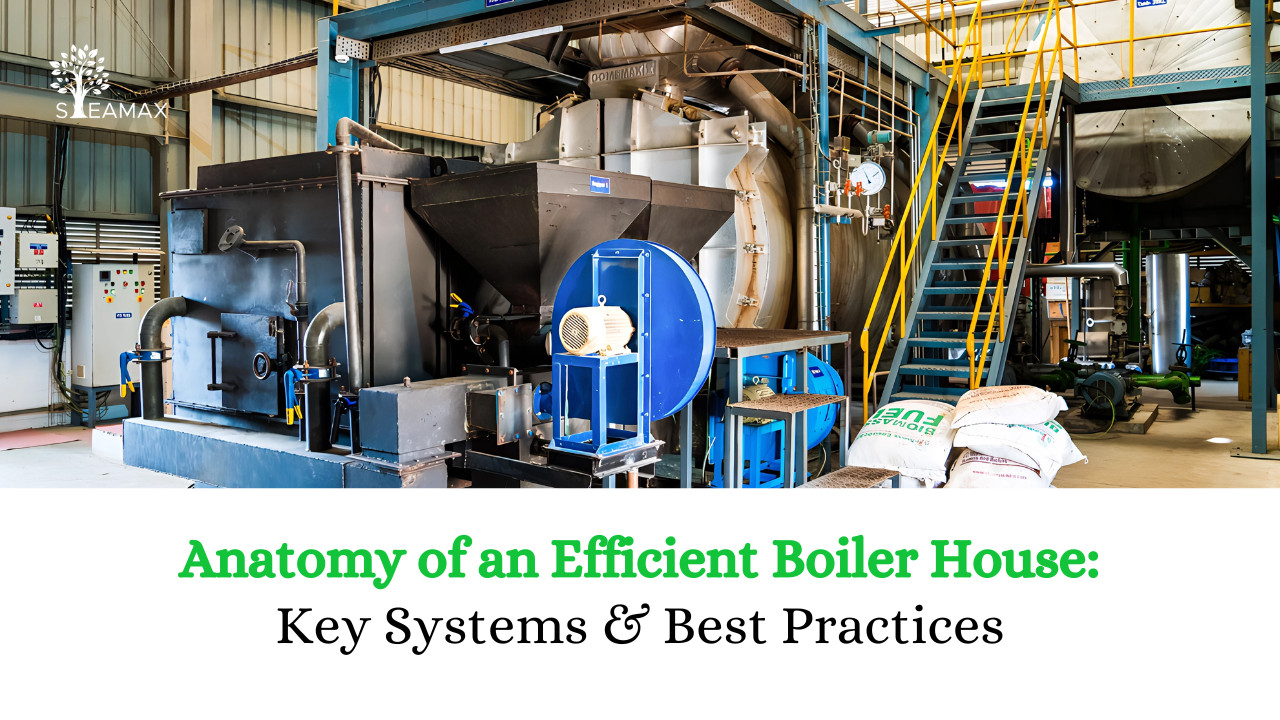
Many industries judge boiler performance by one simple factor: Is steam being generated or not?
But an efficient boiler house is not defined only by steam production.
A plant may continue generating steam while quietly losing money through:
- Excess fuel consumption
- Heat losses
- Poor combustion
- Water quality issues
- Frequent operator intervention
- Emission inefficiencies
That’s why the best-performing industries don’t focus only on the boiler. They focus on the entire ecosystem.
Real efficiency comes from how all connected systems work together.
What Does an Efficient Boiler House Actually Mean?
An efficient boiler house is one where:
- Fuel burns properly
- Steam generation remains stable
- Heat losses are minimised
- Emissions stay under control
- Downtime is reduced
- Operating costs remain predictable
1. Reliable Fuel Handling Is the Starting Point
No boiler can perform efficiently if fuel feeding is inconsistent.
In many industries, poor fuel handling creates problems long before combustion even starts.
Common issues include:
- Non-uniform fuel size
- Fuel moisture variation
- Manual feeding inconsistencies
- Bridging and hopper choking
Efficient boiler houses focus heavily on:
- Proper storage systems
- Controlled fuel feeding
- Uniform fuel preparation
- Automated feeding mechanisms were required
A stable fuel supply creates stable combustion.
2. Combustion Efficiency Defines Performance
Combustion is the heart of the boiler house.
If fuel and air are not balanced correctly, the system begins wasting energy immediately.
Poor combustion leads to:
- High fuel consumption
- Clinker formation
- Smoke generation
- Unburnt fuel loss
- Steam pressure fluctuations
Efficient plants continuously monitor:
- Air–fuel ratio
- Furnace temperature
- Draft balance
- Flame stability
Even small combustion improvements can significantly reduce fuel costs over time.
3. Water Chemistry Is Equally Important
Many efficiency problems begin with poor water quality.
Improper feed water treatment can cause:
- Scaling on tubes
- Corrosion
- Reduced heat transfer
- Increased blowdown losses
An efficient boiler house maintains strict control over:
- TDS levels
- pH balance
- Hardness
- Dissolved oxygen
- Feed water temperature
Good steam starts with good water chemistry.
4. Heat Recovery Plays a Major Role
One of the biggest mistakes industries make is allowing usable heat to escape.
Efficient boiler houses focus on recovering and utilising waste heat wherever possible.
This includes systems like:
- Economizers
- Air preheaters
- Condensate recovery systems
Lower stack temperature often indicates better heat utilisation.
Because every degree of wasted heat eventually becomes a fuel cost.
5. Proper Draft and Flue Gas Management Matters
Many plants ignore flue gas flow until major issues appear.
But poor draft balance affects:
- Combustion quality
- Furnace temperature
- Emission performance
- Fuel efficiency
An efficient boiler house maintains smooth and stable gas flow through:
- Correct ID fan operation
- Balanced draft settings
- Proper duct design
- Clean heat transfer surfaces
6. APCD Systems Are No Longer Optional
Today, emission control is a critical part of boiler house efficiency.
Modern industries must manage both:
- Operational performance
- Environmental compliance
Efficient boiler houses integrate proper APCD systems, such as:
- Bag filters
- Wet scrubbers
- Multicyclones
- Spark arrestors for biomass systems
A well-designed APCD system improves:
- Emission control
- Gas flow stability
- Overall plant safety
7. Automation Reduces Human Dependency
Many operational fluctuations happen because systems depend too heavily on manual intervention.
Automation helps improve consistency in:
- Fuel feeding
- Air control
- Temperature management
- Steam pressure stability
Even partial automation can reduce:
- Fuel wastage
- Operator errors and fluctuations
The goal is not to remove operators, but to support them with more stable systems.
8. Maintenance Is Part of Efficiency
Efficiency is not achieved only during installation.
It is maintained through regular monitoring and upkeep.
Efficient boiler houses prioritize:
- Routine cleaning
- Tube inspection
- Leak detection
- Ash removal
- Fan balancing
Ignoring maintenance slowly increases energy losses that often go unnoticed.
9. Data Monitoring Helps Prevent Hidden Losses
The best-performing plants do not rely only on visual inspection.
They monitor data such as:
- Fuel consumption
- Stack temperature
- Steam-to-fuel ratio
- Flue gas composition
- Emission levels
These indicators help identify efficiency losses before they become expensive operational problems.
The Difference Between an Average and Efficient Boiler House
An average boiler house reacts to problems after they occur.
An efficient boiler house prevents problems before they grow.
That difference affects:
- Fuel cost
- Downtime
- Compliance
- Steam reliability
- Long-term profitability
Final Thoughts
An efficient boiler house is never built around a single component.
It is the result of:
- Good fuel management
- Stable combustion
- Proper water chemistry
- Heat recovery
- Emission control
- Continuous monitoring
When these systems work together, industries achieve:
- Better efficiency
- Lower operating cost
- More reliable steam generation
To explore practical optimisation solutions, visit: https://steamaxindia.com/