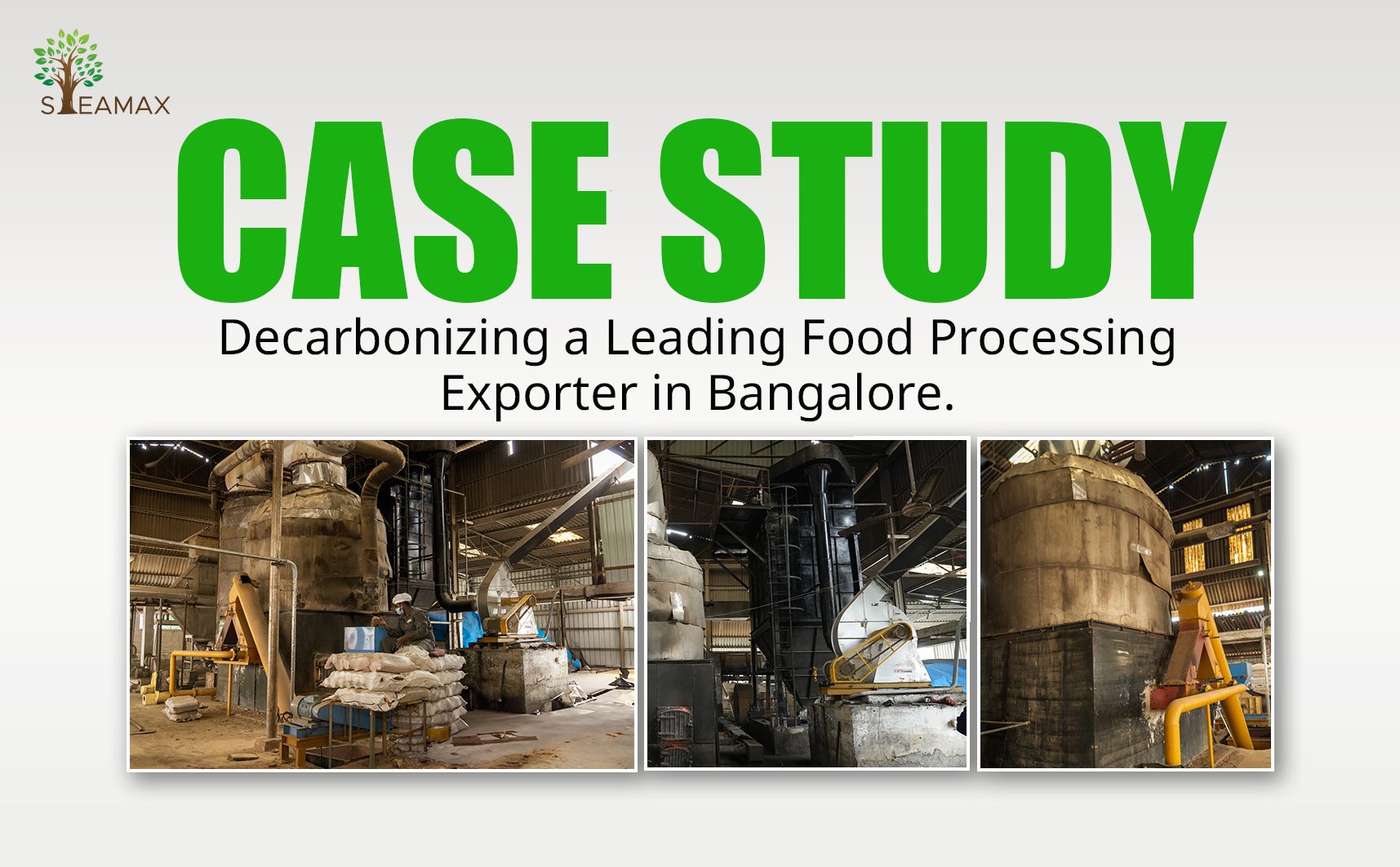
Food processing facilities run on steam at every stage of production. But rising fuel bills and tightening emission norms are making it harder for companies to stay cost-competitive and compliant. One food processing in Bangalore was struggling with this exact issue. Despite relying on biomass briquettes, their monthly consumption and costs were soaring, and they lacked proper emission controls. They needed a more innovative solution that could reduce costs while keeping operations future-ready.
Driven by its focus on sustainable manufacturing practices and energy-efficient operations in the food processing industry, the company set out to adopt advanced solutions that would align with both environmental compliance standards and its long-term sustainability goals. The initiative was aimed at enhancing overall plant efficiency, minimizing carbon emissions, and ensuring more reliable and cost-effective energy utilization through renewable resources such as biomass energy.
The Challenge: High Consumption, No Emission Control
Before the intervention, the company’s situation looked like this:
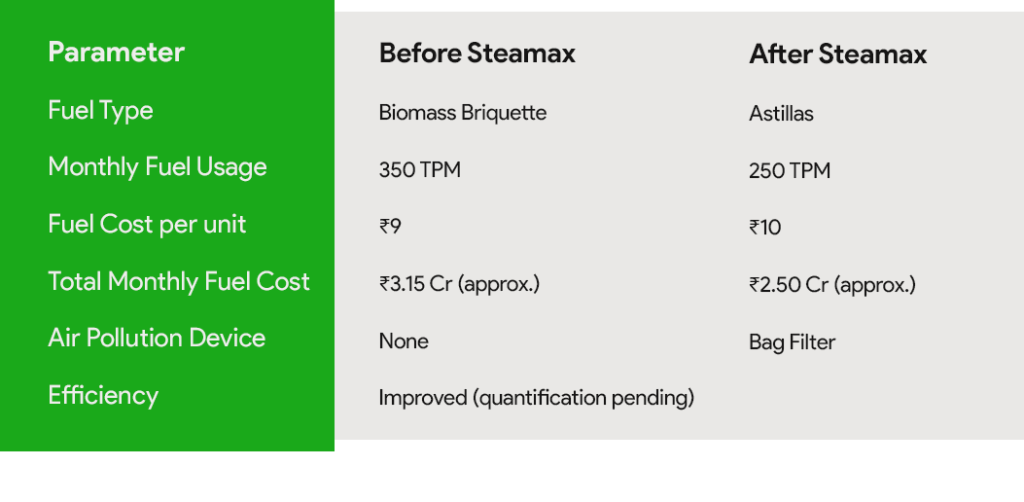
- Fuel Used: Biomass briquettes
- Monthly Fuel Usage: 350 tons
- Fuel Cost: ₹9/kg
- Monthly Fuel Bill: ₹3.15 crore
- Emission Control: Not applicable this stage
Key Points
- Excessive fuel consumption is required to achieve the necessary steam output.
- High operational costs, eroding profitability.
- Moderate particulate emissions, with no bag filter or APCD in place.
- Compliance risks are increasing as emission standards continue to tighten.
Steamax’s Solution for the food processing
To address these issues, Steamax introduced a targeted retrofit strategy that improved both efficiency and compliance.
Key Interventions
- Auto Fuel Feeding Kit (AFK):
- Automated the fuel feeding process.
- Improved combustion efficiency by reducing manual errors.
- Reduced wastage and inconsistencies in operation.
- Bag Filter Installation:
- Captured particulate matter emissions.
- Delivered cleaner, more compliant operations.
- Brought the facility in line with future regulatory expectations.
- Fuel Shift – From Briquettes to Astillas:
- Transitioned to a more efficient biomass fuel.
Although Astillas cost slightly more per kg (₹10), its higher efficiency reduced overall consumption.
The Results: Lower Bills, Cleaner Operations
The impact of the intervention was clear within months
- Fuel Consumption: Reduced from 350 tons/month → 250 tons/month.
- Unit Fuel Cost: Increased from ₹9/kg to ₹10/kg.
- Monthly Fuel Bill: Dropped from ₹3.15 crore to ₹2.50 crore.
- Savings Achieved: ₹65 lakhs/month (20.6% reduction).
- Emissions: Cleaner, with a bag filter reducing particulate output.
Broader Benefits
- Economic Gains: Substantial cost savings despite a higher per-unit fuel price.
- Environmental Impact: Cleaner operations aligned with sustainability goals.
- Future Flexibility: The retrofit system is capable of handling multiple biomass fuels and scaling to higher TPH capacities.
Final Thoughts
This case shows how even companies already using biomass can achieve significant savings and compliance improvements through smarter fuel choices and retrofitting. By transitioning from briquettes to Astillas and implementing modern systems such as AFK and bag filters, the food processing in Bangalore transformed rising costs and compliance risks into a long-term competitive advantage.