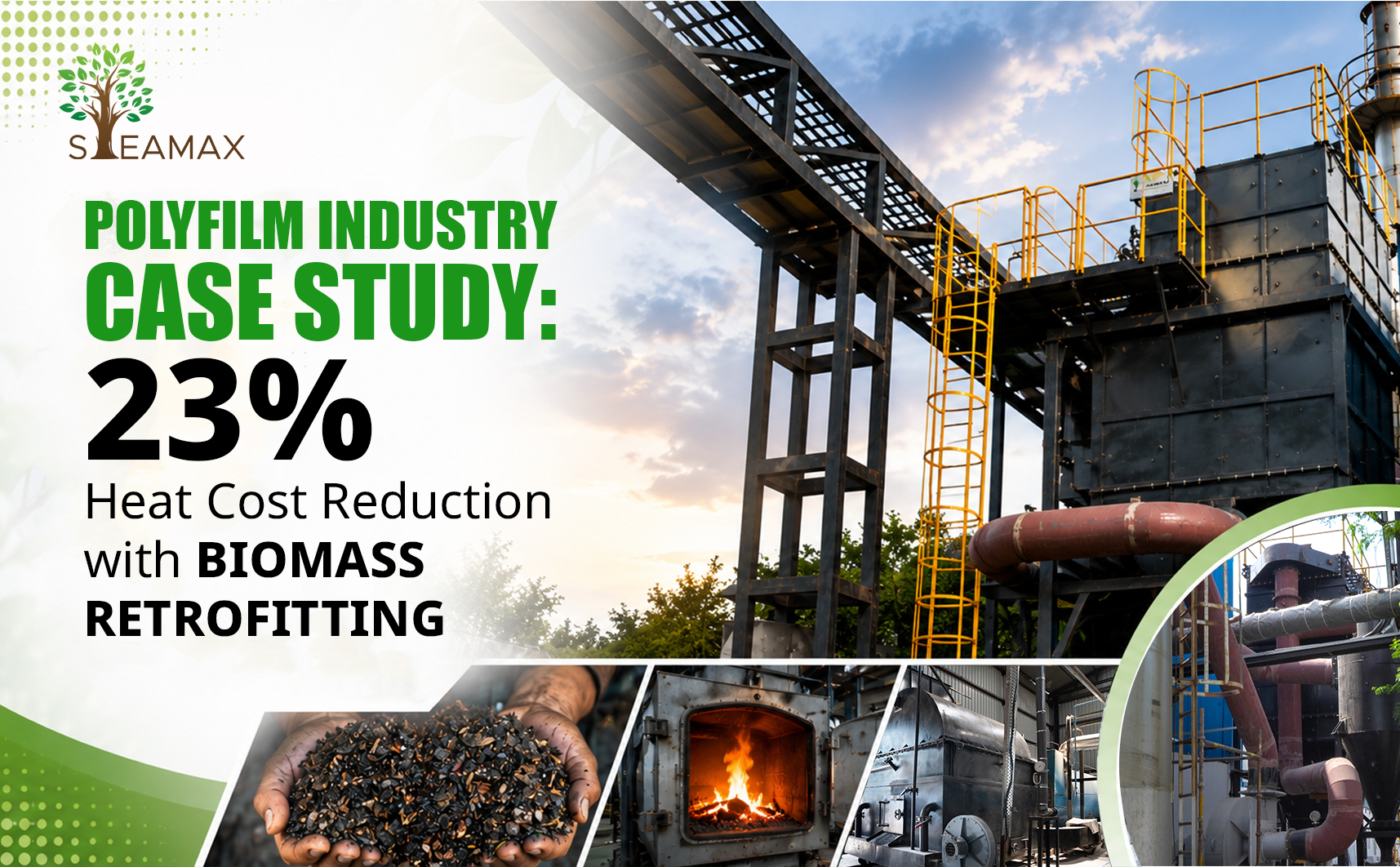
For industries that rely on thermic fluid heaters (TFHs), fuel is one of the largest operating expenses. When that fuel is LPG, rising prices can significantly impact production costs and profitability. A leading polyfilm manufacturer was facing a similar challenge. The plant relied on LPG-fired thermic fluid heaters, resulting in annual heating costs exceeding ₹7.3 crore. At the same time, the company wanted to move toward a cleaner and more economical fuel without compromising production.
Project Overview for Polyfilm industry
To improve the economics of heat generation, the company partnered with Steamax to retrofit one of its gas-fired thermic fluid heaters to operate on biomass.
The project included:
- Industry: Polyfilm Manufacturing
- Existing Fuel: LPG
- New Fuel: Astillas Biomass (with pellet compatibility)
- Steamax Solution: GBR Kit for Biomass Retrofitting
- Heat Output After Retrofitting: 25 lakh kcal/hr
- Investment (CAPEX): ₹115 lakh
- Expected Payback: 8 months
The Challenge
The company wanted to reduce heating costs while maintaining reliable thermic fluid generation.
The key concerns included:
- High dependence on expensive LPG
- Increasing fuel price volatility
- Need for an environmentally friendly fuel
- Maintaining continuous production
- Selecting a biomass fuel that would not create excessive ash and maintenance issues
Rather than replacing the existing TFH, the objective was to maximise the value of the current infrastructure through retrofitting.
Why Fuel Selection Was Critical
Not all biomass fuels perform the same way.
While rice husk was readily available, it also came with operational challenges such as:
- Higher ash generation
- Increased clinker formation
- More frequent shutdowns for cleaning
- Greater solid waste handling
Steamax recommended Astillas as the primary fuel because of its higher calorific value, lower ash content, and improved combustion efficiency. The proposal also allowed the use of quality biomass pellets as an alternative fuel.
The Steamax Solution for Polyfilm industry
Instead of installing a completely new heating system, Steamax retrofitted the existing LPG-fired thermic fluid heater with its GBR (Gas-to-Biomass Retrofitting) Kit.
The solution included:
- Biomass burner retrofit
- Optimised combustion system
- New ID fan and secondary fan
- Fuel feeding system
- Bag Filter with Spark Arrestor
- Complete fuel and ash handling system
- Variable Frequency Drives (VFDs) for improved control
This approach allowed the company to transition to biomass while utilizing its existing infrastructure.
Operational Improvements Beyond Fuel Savings
The project delivered more than lower fuel costs.
Using Astillas offered several operational advantages:
- Approximately 32–33% lower biomass consumption compared to rice husk.
- Around 90% reduction in solid waste (ash and clinker) compared to rice husk.
- Better combustion efficiency due to lower ash content.
- Reduced dependence on LPG during monthly operations.
- Lower electricity consumption because less fuel and ash need to be handled.
These improvements helped reduce maintenance requirements while supporting smoother plant operation.
Results Achieved
Following the retrofit, the plant achieved:
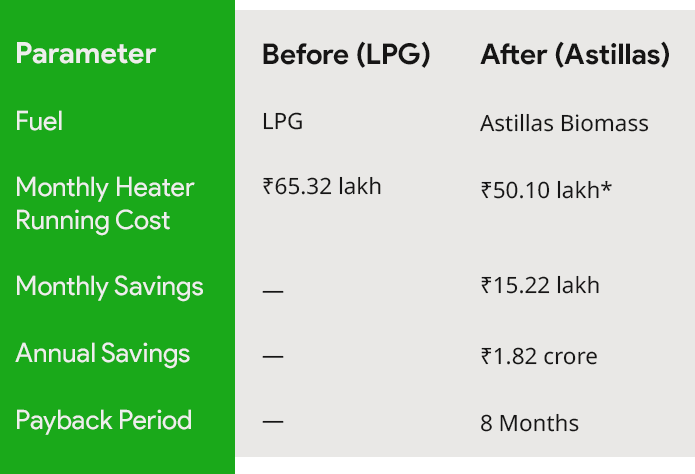
- 23% reduction in overall heat cost
- Monthly savings of ₹15.22 lakh
- Annual savings of approximately ₹1.82 crore
- Payback on investment in just 8 months
- Reduced dependence on fossil fuels
- Cleaner and more sustainable heat generation
Key Takeaway
Many industries assume that lowering energy costs requires investing in completely new equipment.
This project demonstrates that retrofitting existing thermic fluid heaters can be a practical and cost-effective alternative.
By combining the right biomass fuel with engineered retrofitting and efficient pollution control, industries can significantly reduce operating costs while making better use of their existing assets.
Final Thoughts
For industries operating LPG- or gas-fired thermic fluid heaters, fuel costs will continue to influence profitability.
This case study shows that a well-planned biomass retrofit can deliver substantial savings, faster payback, and a cleaner energy solution without replacing the entire heating system.
Planning to reduce your heat generation costs without replacing your existing thermic fluid heater?
Contact Steamax to explore customised biomass retrofitting solutions, advanced combustion systems, and pollution control technologies designed for long-term savings and reliable performance. Visit https://steamaxindia.com/