

Problem Statement Of Poha Industry:
The poha manufacturing industry, particularly in regions like Indore and Ujjain, has long struggled with two significant issues: the emission of black smoke and excessive fuel consumption in its 6 Lac Kcal/hour roasters.
Our Solution
In the areas around Indore and Ujjain, approximately 50 poha roasting units process paddy into flattened rice flakes, commonly known as poha. These units traditionally used sawdust as their primary fuel for heat generation during roasting. However, this method had significant drawbacks: high levels of black smoke and solid particulate emissions were discharged from these units’ chimneys far beyond permissible limits.
Smoke and particulates harm the environment and cause distress among nearby communities, government authorities, and the pollution control board. To address these concerns, the Ujjain Poha Association transitioned to an automatic fuel-feeding system using cleaner biomass fuel, which aligns with the Central Pollution Control Board (CPCB) regulations. They approached Steamax to upgrade their processes and air pollution control systems.
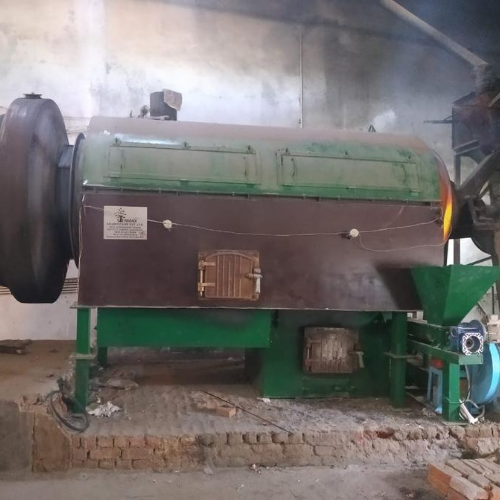
Steamax’s Intervention: Our Approach to the Problem
Upon analyzing the situation, Steamax investigated the roasting process used in these poha manufacturing units. We then designed a new heating system specifically tailored for these units, the “Multifuel Poha Roaster Heater.” After successful prototype model trials, the first commercial unit was installed on September 19, 2019, in Ujjain. Steamax introduced a clean biomass fuel blend, Astillas, and this new system to the poha manufacturers.
Through this intervention, Steamax upgraded the roasting systems, making the entire process far more environmentally friendly. This shift to cleaner fuel and advanced technology brought several benefits to the Ujjain poha industry.
Environmental Benefits
- Cleaner Operations: The roasting process is much cleaner, completely eliminating dust and black smoke.
- Reduction in Particulate Emissions: Emissions from the roasters’ chimneys have dropped significantly, now well below the 800 ppm limit set by CPCB.
- Lower Solid Waste: The amount of solid waste (ash and clinker) produced during the roasting process has reduced drastically—from 15-20% to just 2% of the total fuel input.
Economic Benefits
- Reduced Fuel Consumption: The new system has resulted in lower fuel consumption, directly reducing the overall cost of the roasting process.
- Improved Product Quality: With better system efficiency and uniform heat distribution, the quality and quantity of the roasted poha have increased.
- Labour Savings: Implementing an automatic fuel-feeding system has reduced the need for manual labour in the roasting process.
- No Equipment Downtime: Since the system upgrade in September 2019, zero reported heater breakdowns have been reported.
- Reduced Ash Disposal Costs: The significant reduction in solid waste has also led to lower costs for ash disposal.
Need detail about this Sydtem
Kindly reach out to +91-9315124803
Wow, great story, Ive added you as a friend on my Facebook!
Im impressed, I must say. Very rarely do I come across a blog that is both educative and entertaining, and let me tell you, you have hit the nail on the head. Your idea is important; the issue is something that not enough people are talking intelligently about. Im really happy that I stumbled across this in my search for something relating to this.
I enjoyed reading through your post. I really agree with what you wrote.