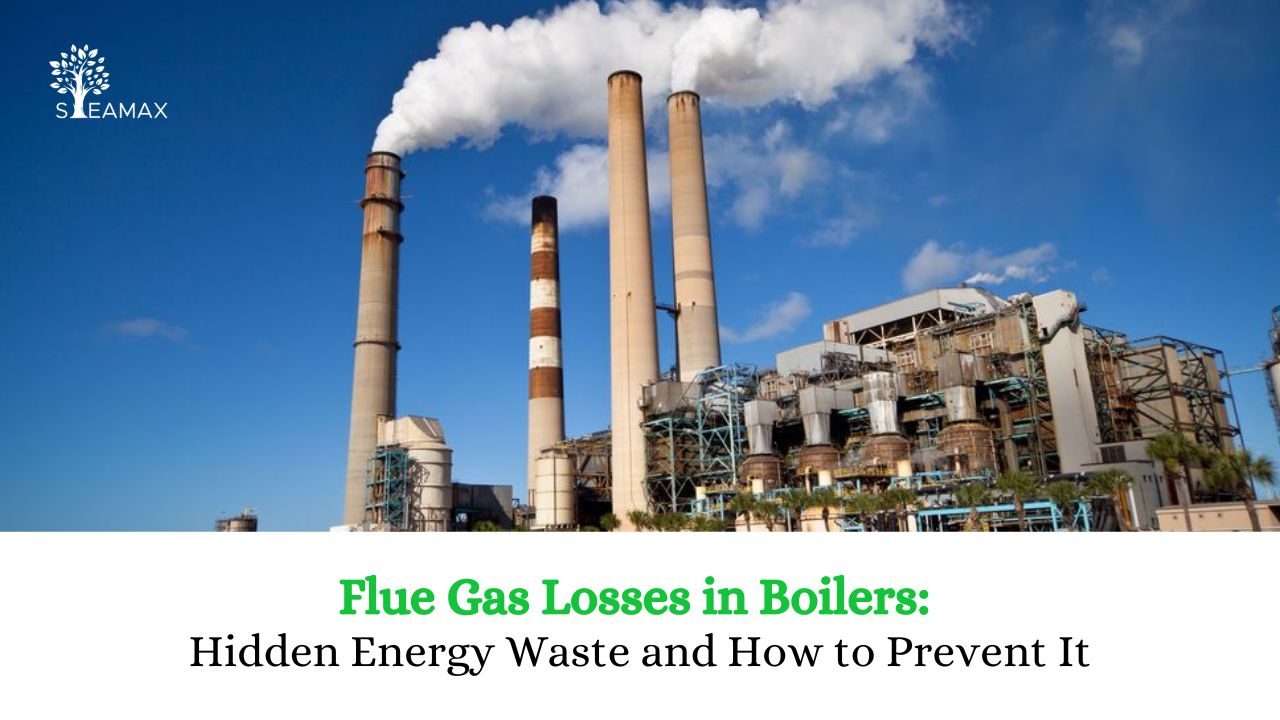
Every boiler operator knows that fuel bills are one of the most significant operational costs. But what many don’t realize is how much of that energy — sometimes up to 15–25% — is literally going up the stack. That’s right. The hot gases leaving through the chimney or flue carry a significant amount of unutilized heat energy. This loss, known as flue gas loss, quietly reduces overall boiler efficiency and drives up fuel consumption. Understanding what causes flue gas losses and how to control them can directly translate into lower costs, improved performance, and a smaller carbon footprint.
What Are Flue Gas Losses?
In simple terms, flue gas losses refer to the heat energy that escapes through the exhaust gases of a boiler. When fuel burns inside the furnace, it generates hot combustion gases that transfer heat to the water or steam system. However, not all that heat gets absorbed — a portion exits through the flue or stack.
Major Causes of Flue Gas Losses
1. Excess Air in Combustion
Using more air than necessary for combustion can cool down the flame and carry unburnt heat out through the flue. Most industrial boilers operate optimally at 10–20% excess air, but poorly tuned systems often exceed this range.
2. Poor Heat Transfer Efficiency
Soot, ash, or scale buildup on heat transfer surfaces, such as tubes or economisers, can reduce heat absorption, thereby increasing flue gas temperature and resulting in higher losses.
3. Incomplete Combustion
When combustion is inefficient, more carbon monoxide (CO) and unburned fuel are formed, wasting potential heat energy and resulting in higher emissions.
4. Improper Load Operation
Running boilers at very low or fluctuating loads can increase losses, as heat transfer efficiency decreases and stack temperatures rise.
5. Lack of Heat Recovery Systems
Without heat recovery equipment, such as economisers or air preheaters, valuable waste heat is lost to the atmosphere rather than being reused.
How to Prevent Flue Gas Losses
Reducing flue gas losses doesn’t always require expensive upgrades — just a combination of good maintenance, smart controls, and energy-efficient equipment.
- Regularly measure stack temperature using flue gas analyzers. The ideal exhaust temperature for most biomass or gas-fired boilers should be between 140 °C and 180 °C.
- Utilise oxygen (O₂) analyzers and airflow controls to maintain the optimal air-to-fuel ratio.
- Schedule regular soot blowing or descaling to remove carbon, ash, or scale buildup on boiler tubes.
- An economizer captures residual heat from flue gases and utilizes it to preheat the boiler feedwater. This can recover up to 10% of lost energy.
- Air preheaters use waste heat to warm the combustion air, improving fuel burn quality and reducing stack losses. This is especially useful in large industrial setups.
Flue Gas Loss Reduction with Steamax Solutions
At Steamax, we specialize in helping industries reduce flue gas losses through:
- Economizers and Air Preheaters: Custom-designed for biomass and oil/gas-fired boilers to capture waste heat.
- Combustion Optimization Kits: Including automated air-fuel control systems to maintain ideal combustion conditions.
- Emission Control Devices, such as bag filters and cyclones, not only ensure compliance but also improve system efficiency.
- Performance Audits: On-site boiler and flue gas analysis to identify efficiency gaps and provide actionable solutions.
Final Thoughts: Efficiency Is the Best Fuel
Flue gas losses are often overlooked because they’re invisible — but their impact is very real. A few degrees of excess stack temperature or a bit too much air in the combustion process can quietly drain lakhs every year.
By adopting proactive maintenance, proper monitoring, and modern heat recovery systems, industries can reclaim that lost energy and move closer to both cost efficiency and sustainability goals. Want to know how much you could save by reducing flue gas losses? Visit orangered-antelope-537718.hostingersite.com to discover energy optimization solutions that deliver a measurable impact.