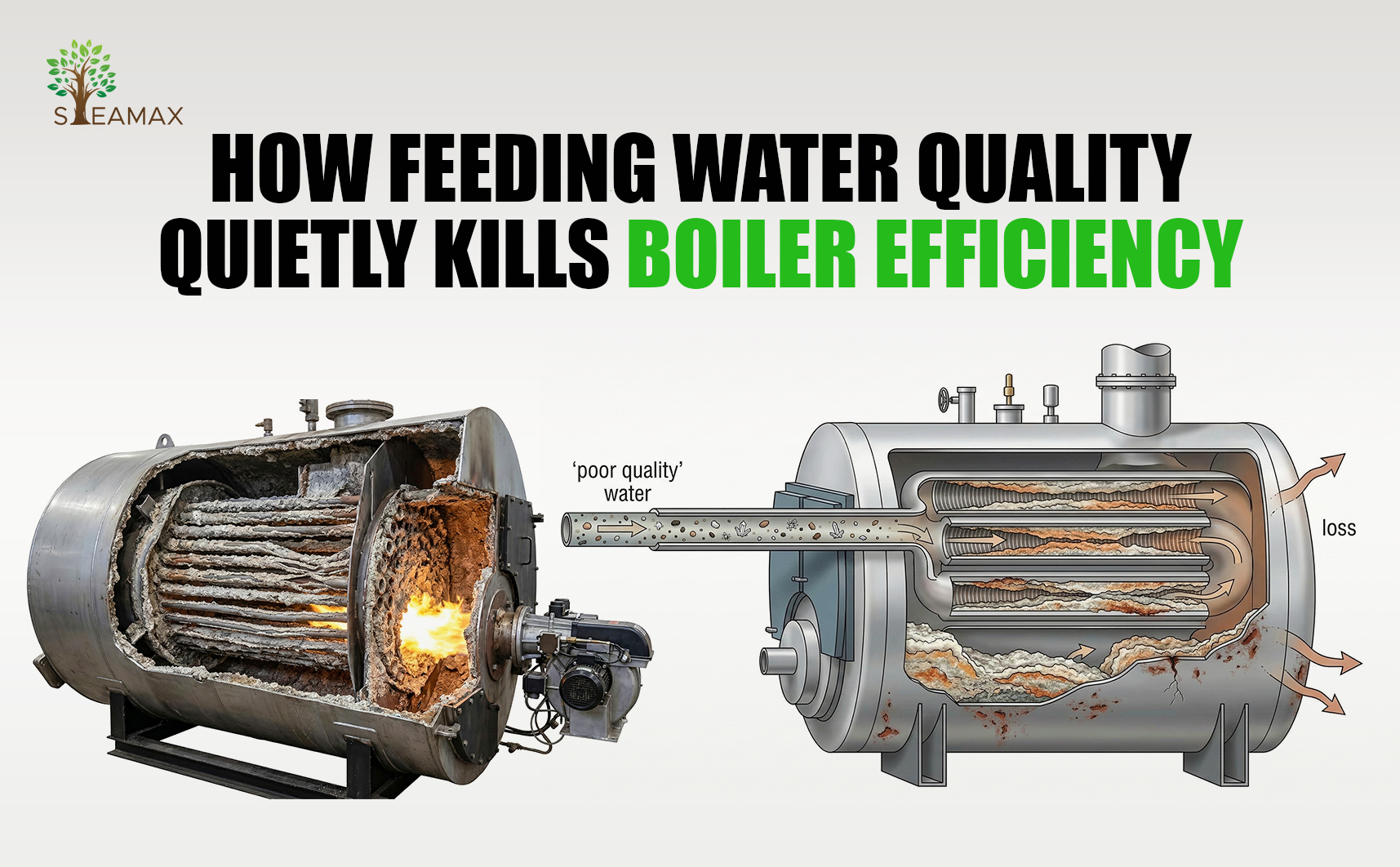
When boiler efficiency drops, most plants blame fuel quality, combustion tuning, or heat losses. Very few immediately look at the feed water. But here’s the reality: boiler feed water quality directly affects efficiency, heat transfer, fuel consumption, and equipment life. Unlike fuel issues, water chemistry problems do not show immediate alarms. They build up slowly — forming scale, causing corrosion, increasing blowdown, and quietly driving up steam cost.
If your boiler is consuming more fuel than expected, unstable, or demanding frequent maintenance, the root cause might not be in the furnace. It could be in the feed water tank.
Understanding Boiler Feed Water Chemistry
Boiler feed water is never pure. Even treated water contains dissolved minerals and impurities. The chemistry of this water determines how it behaves at high temperatures and pressures.
Key chemical components that impact performance include:
- Hardness (Calcium and Magnesium salts)
- Total Dissolved Solids (TDS)
- Dissolved Oxygen
- Silica
- Alkalinity (Carbonates and Bicarbonates)
- pH Level
When exposed to high temperatures, these components react, precipitate, or corrode metal surfaces.
How Hardness Causes Scaling and Heat Loss
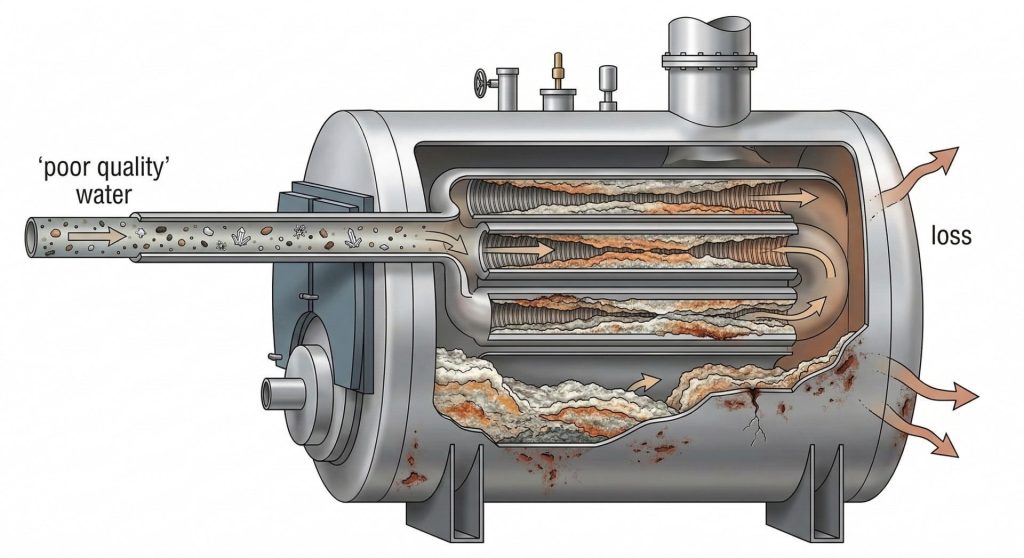
Hardness is one of the most significant factors affecting boiler efficiency. Calcium and magnesium salts precipitate at high temperatures, forming hard deposits on heat transfer surfaces.
Even a thin scale layer significantly reduces heat transfer efficiency.
For example:
- 1 mm of scale can reduce heat transfer efficiency by 5–10%
- Thicker deposits can increase fuel consumption by 15% or more
The reason is simple. Scale acts as insulation. The boiler must burn more fuel to transfer the same amount of heat to water.
Over time, this leads to:
- Higher stack temperatures
- Increased fuel cost
- Tube overheating
- Risk of tube failure
TDS and the Hidden Cost of Blowdown
Total Dissolved Solids (TDS) represent dissolved minerals in water. High TDS levels lead to foaming and carryover, affecting steam purity.
To control TDS, boilers require blowdown — the removal of concentrated water from the system.
Excessive TDS means:
- More frequent blowdown
- Loss of hot water and energy
- Increased make-up water demand
- Higher chemical consumption
Dissolved Oxygen and Corrosion Damage
Water naturally contains dissolved oxygen. At high temperatures, oxygen reacts aggressively with steel surfaces, leading to corrosion.
Corrosion results in:
- Pitting of boiler tubes
- Reduced metal thickness
- Leakages
- Shortened equipment life
Oxygen-related corrosion is often localised and dangerous because it weakens the boiler structure from the inside.
Proper deaeration and the use of oxygen scavengers are essential to prevent this.
Silica and Steam Contamination
Silica is particularly problematic in high-pressure boilers. When present in feed water, it can vaporise with steam and deposit on turbine blades or downstream equipment.
High silica levels cause:
- Reduced heat transfer
- Deposits in superheaters
- Lower steam purity
- Damage to process equipment
Silica control becomes critical in plants where steam quality directly impacts production.
pH and Alkalinity: Balancing Act Inside the Boiler
The pH level of feed water determines whether the internal environment is corrosive or scale-forming.
- Low pH leads to acidic corrosion
- High alkalinity promotes scaling and foaming
Maintaining the right chemical balance is essential. Boiler water chemistry is not just about removing hardness; it is about maintaining stable chemical conditions.
What a Poor Water Quality Impacts Overall Efficiency
When feed water chemistry is not properly controlled, the effects combine:
- Reduced heat transfers due to scale
- Increased fuel consumption
- More frequent blowdown
- Higher chemical treatment costs
- Unexpected downtime
- Shortened boiler lifespan
The impact is gradual, which makes it dangerous. Plants may not notice the efficiency drop immediately, but fuel bills and maintenance costs tell the story over time.
Best Practices to Protect Boiler Efficiency
Improving feed water quality requires a systematic approach:
- Proper water softening or RO treatment
- Deaeration to remove dissolved gases
- Continuous monitoring of TDS and pH
- Regular chemical dosing and testing
- Periodic inspection of heat transfer surfaces
Final Thoughts
Boilers are designed to convert water into steam efficiently. But when the water itself carries dissolved minerals and reactive gases, efficiency quietly suffers.
Fuel may be expensive, but poor water chemistry can make it even more costly to burn. Addressing feedwater quality is one of the most practical and cost-effective ways to protect efficiency, reduce steam costs, and extend equipment life.
If your boiler efficiency is slipping without a clear cause, it may be time to examine the chemistry of your feedwater.